

Padel racket rules are defined in the equipment article of the official FIP rules: the racket must have a perforated surface, its total length including the strap must not exceed 45.5 cm, its width 26 cm and its thickness 38 mm, the hitting surface must be perforated, and the player must use a strap (wrist strap) that secures the racket to the wrist. In short: a strung racket like a tennis racket is not valid in padel, and you can’t play an official match with a racket that has no strap.
In this article we break the racket rules down point by point: which dimensions are the limits, why hole diameters are standardized, why the wrist strap is a safety rule, what an approved racket means and how equipment is checked at tournaments. If you want to see the rules as a whole, complete guide to padel rules is a good place to start; here we only cover the articles about the tool in your hand.
Summary
- The racket must have a solid, perforated face, not strings; you cannot use a tennis racket in padel.
- The total length cannot exceed 45.5 cm, the width 26 cm and the thickness 38 mm.
- The holes on the hitting surface must be within a set diameter range and evenly distributed.
- The wrist strap is mandatory in official matches; a point played with a racket without a strap may be ruled invalid.
- At tournaments, only federation-approved rackets bearing an approval mark are accepted.
What is a padel racket by rule? Why strung rackets aren’t allowed
The rules define the racket by its features, not by product name. Accordingly, a padel racket is a tool made as a single piece, consisting of a handle, a frame and a perforated hitting surface, with no string mesh. There is no open gap (throat) between the hitting surface and the handle as there is on a tennis racket.
The consequence for play is this: in padel you push the ball with the stiffness and foam structure of the face, not with string tension. The rules give manufacturers freedom over materials but tightly limit geometry. Carbon, fiberglass, EVA foam or combinations of these are allowed; dimensions and hole patterns are not free.
The rule also has a safety side. Four players constantly turn and move in an enclosed 20×10-meter space; a tool with pointed tips, sharp edges or a weighted end is a risk to both opponents and partners. That’s why the racket’s edge profile and protector tape are also subject to inspection.
The equipment section of the rules is short and deliberately restrictive. The federation wants the player to be the only thing that defines the character of the game; the tool should be a constant, not a variable. This approach is one of the most important regulatory differences between padel and tennis, and padel vs tennis rule differences it is covered comparatively in this article.
Dimensions: length, width, thickness and surface limits
The rules give dimensions down to the millimeter. Almost every mass-produced racket on the market is within these limits; problems usually arise with customized rackets, extended handles or heavy added tape.
| Dimensions | Rule limit | What it means in practice |
|---|---|---|
| Total length (including handle) | Maximum 45.5 cm | Thick tape or an extension added to the butt of the handle can exceed the limit. |
| Width | Maximum 26 cm | The widest point of round-head rackets is the design that comes closest to this limit. |
| Thickness (profile) | Maximum 38 mm | The standard profile is already 38 mm; you can’t gain an advantage by increasing thickness. |
| Hitting surface length | The face is limited to a portion of the total length | You can’t shorten the handle and enlarge the face; the ratio is preserved. |
| Wrist strap length | Limited; the rules specify a maximum | The strap must be short enough to keep the racket from flying away if it leaves your hand. |
| Weight | No upper limit in the rules | Weight is free; the choice depends entirely on the load on the player’s shoulder and wrist. |
The lack of a weight rule is often misunderstood. The rules don’t protect you; your shoulder does. That’s why load logic, not the rules, should decide your weight preference. The details padel racket weight and balance article.
All the dimension limits rest on the same logic: the racket should be a natural extension of the arm and nothing more. The length limit caps reach at the net, the width limit caps forgiveness on mishits, and the thickness limit caps the power that comes from foam volume. Together, they ensure the player, not the tool, decides the game.
One point deserves emphasis: the dimension limits also apply when you rent a racket. Club rackets are mass-produced so there’s no problem, but a racket with a thick second grip wrapped on the handle or a tip weighted with tape can technically fall outside the limits. That’s why not modifying a borrowed racket before a tournament is the safest approach.
Holes and surface: what’s allowed and what isn’t
The perforated face is padel’s identity. The rules keep hole diameters within a set range and require an even distribution across the surface. The goal is to make the ball’s air resistance and bounce behavior predictable and to prevent artificial effects from holes concentrated in one area.
- Hole diameter: A racket with holes outside the specified range is not compliant. This is a violation almost never seen on factory rackets.
- Hole distribution: Must be even across the face; special patterns concentrated in the center fail inspection.
- Surface texture: Slightly rough surfaces are allowed; protrusions or coatings that mechanically add extra spin are not.
- After-market modification: Drilling extra holes, sanding the face, or adding sand or resin takes the equipment outside the rules.
- Frame protector: Edge tape is allowed but must not exceed the size limits. Frame protector That is why choosing one is a matter of both maintenance and compliance.
- Breaks and cracks: The rules don’t allow playing with a racket broken in a way that compromises safety.
In practice, the most common problem we see is not a rule violation but the habit of continuing to play with a cracked racket. A cracked face sends the ball unpredictably and increases the load on your elbow. To learn how to read your racket’s lifespan, when to replace a padel racket article.
The wrist strap requirement: the rules’ only true safety article
In padel, the wrist strap is not an optional accessory but a rule. If the racket flies out of your hand, the strap keeps it attached to your wrist; on a small, enclosed court, this is the simplest measure to prevent serious injury.
How the strap is used is defined too: it must be around the wrist throughout play. A strap attached to the handle but not on the arm doesn’t meet the purpose of the rule. Tournament referees start with a warning on this; if it happens again, an equipment non-compliance procedure may be applied.
The strap also has a technical benefit. A racket attached to your wrist lets you loosen your grip on hard bandeja and víbora shots; without the fear of losing it, the hand works more freely. With our beginner players, we see grip pressure drop noticeably once the strap habit sets in.
Practical notes on the strap
- The strap should fit snugly on the wrist; a very loose strap lets the racket swing away.
- Replace a worn, frayed strap; it usually snaps on the hardest shot.
- When changing the grip, check the strap’s anchor point; straps pinched under the grip tear easily.
- If you use a rental racket, checking the strap before the match is your responsibility.
You can try out our rule-compliant, well-maintained rental rackets on our courts and, with a coach, decide when to switch to your own racket.
What does an approved racket mean? Equipment checks at tournaments
Federation approval means the manufacturer has documented the racket’s compliance with the dimension and surface rules and the product bears the relevant approval mark. This mark is checked at official tournaments; it isn’t checked in friendly club matches.
Checks usually work in this order: an equipment declaration at registration, a visual check before the match, and measurement if there’s a challenge. Measurement is mostly of length and width, because those are the two dimensions most often modified after purchase.
| Setting | Approval mark | Wrist strap | Check method |
|---|---|---|---|
| Friendly club match | Not required | Strongly recommended | Player’s responsibility |
| Americano / Mexicano | Not required | Expected | Organizer |
| Club league | Recommended | Mandatory | Visual check before the match |
| Official tournament | Mandatory | Mandatory | Registration + referee check |
If you are entering a tournament for the first time, you can find all the equipment expectations in the padel tournament rules and tournament clothing and equipment rules articles, in that order.
Five commonly confused points
Information that circulates among players who haven’t read the rules is usually half true. Let’s correct the ones we hear most often.
- “A heavy racket is against the rules.” It isn’t. There is no upper weight limit in the rules; the limits are on dimensions and surface.
- “There’s a rule that round rackets are for amateurs and diamond rackets are for pros.” There is no such rule; shape is entirely a matter of preference. We compared them padel racket shapes in this article.
- “The strap is only required at tournaments.” The rule binds official matches, but the safety reason is the same in every match.
- “If I hit the ball twice with the racket, the dimension rule applies.” No; a double hit is a rule of play, not an equipment issue. You can find these situations in the double bounce and net contact article.
- “Rental rackets don’t have to comply with the rules.” As a club responsibility, we provide compliant equipment; there is no difference in the rules.
Choosing the right racket is a separate topic that comes after knowing the rules. If you want to build your selection criteria from scratch, how to choose a padel racket our guide walks through the process step by step; if you’re just starting out, padel rackets for beginners this article offers a faster shortcut.
People also wonder about the challenge process. If a player thinks an opponent’s racket is non-compliant, they report the challenge to the organizers between games, not during a point. If non-compliance is confirmed, the player must switch to a compliant racket; points played up to that moment are generally considered valid, but the final decision depends on the tournament regulations. Handling disputes in matches without a referee matches without a referee and fair play article.
How do racket rules affect your game?
Because the rules fix the geometry, the difference between players shows up in how the tool is used, not in the tool. A perforated face puts less spin on the ball than in tennis; that’s why control in padel is built more on placement and timing than on spin.
For the same reason, changing rackets doesn’t give you the jump you expect. When dimensions are fixed, gains can only come from balance, stiffness and grip fit. On the grip side, padel racket grip article, and the full set of rules in padel rule myths .
Conclusion: play with rule-compliant equipment at Skyland
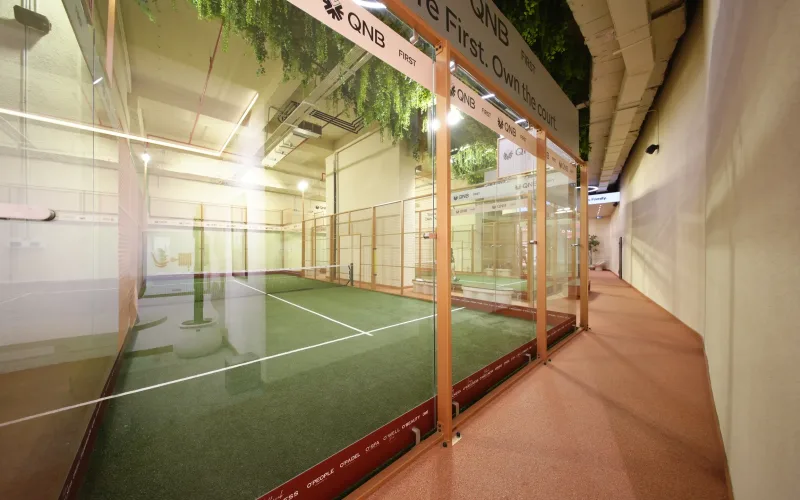
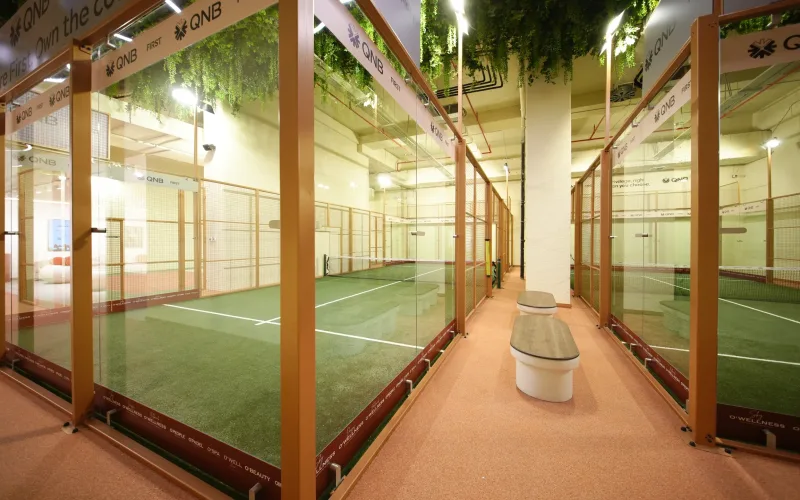
Racket rules are the clearest, least disputed part of padel: dimensions are fixed, the face is perforated, the strap is mandatory. Everything else is your playing preference. On our indoor, climate-controlled courts at Skyland Istanbul, we regularly check our rental rackets and track strap and frame wear, so our players coming from Sarıyer, Maslak and Ayazağa can focus on the game without worrying about equipment compliance. Browse our courts are worth exploring, with our padel lessons you can plan your switch to the right racket with a coach’s support, or directly when making your court reservation today.
FAQ
No. The rules define the racket as a tool with a solid, perforated hitting surface; strung rackets fall outside this definition. A point played with a tennis racket is against the rules and isn’t accepted at clubs either.
In official matches, the referee first gives a warning; if you persist, an equipment non-compliance procedure may be applied and you can’t continue playing. In club matches there may be no penalty, but the risk is the same: a racket flying out of your hand is a cause of serious injury on an enclosed court.
If it’s a mass-produced model from a known brand, it already complies. To be sure, look for the federation approval mark on the product, and make sure any tape or extension you’ve added to the butt of the handle doesn’t increase the total length.
It isn’t. Hole diameter and distribution, as well as surface texture, are covered by the rules; after-market modifications make the racket non-compliant. Care only covers cleaning, grip changes and replacing the frame protector.
It’s the club’s responsibility that the equipment it provides complies with the rules; checking the strap and frame before the match is the player’s. At O'Padel Sky, we periodically review our rental rackets and retire worn ones.


 Padel Courts
