
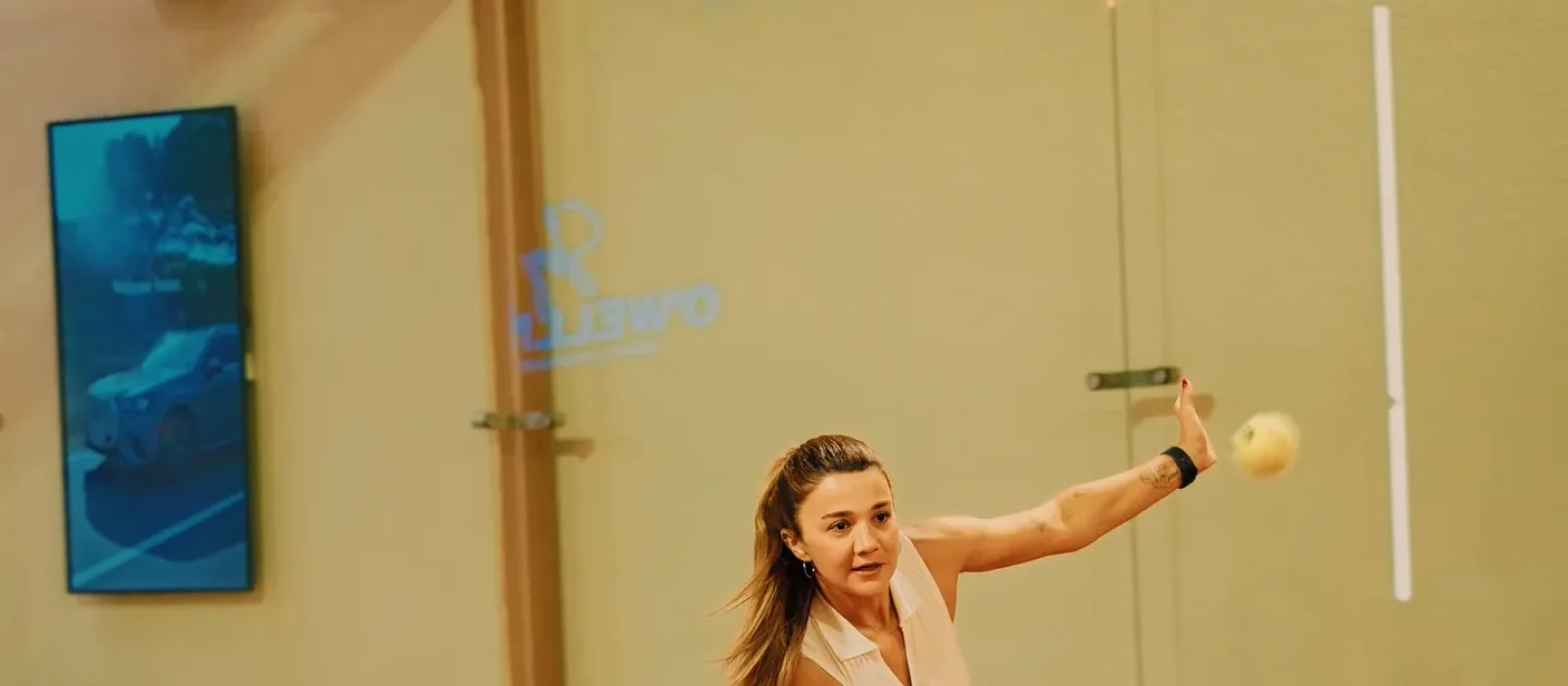
Indoor court visibility quality is determined by the strength and distribution of the lighting, the contrast between the ball and the background, reflections on the glass surfaces, and the player’s own eyesight and equipment. While sunglasses and a cap can matter on an outdoor court, sunglasses are generally not needed indoors; what really counts here is shadow-free, evenly distributed lighting, good contrast and, if needed, suitable sports glasses or contact lenses.
In this guide, the O’Padel Sky coaching team explains the factors that affect visibility on an indoor court, how lighting and contrast influence the game, practical tips for players who wear glasses or contact lenses, protective eyewear, and how to improve your visual tracking skills. On eye health topics, this article is for general information only; if you have a vision problem, you should consult an eye doctor.
Summary
- On an indoor court, visibility depends most on the strength, distribution and shadow-free quality of the lighting.
- Contrast between the ball and the walls, floor and background makes the ball easier to track.
- Sunglasses are generally not needed on an indoor court; some players may prefer protective sports eyewear.
- If you wear glasses or contact lenses, talk to your eye doctor about options suitable for sport.
- Visual tracking skills can be improved with regular practice.
Why Is Vision So Important in Padel?
Padel is a sport that demands quick reactions. On the compact court, the ball comes at high speed from short distances, changes direction as it bounces off the glass walls and climbs high on lobs and smashes. The earlier and more clearly you see the ball, the faster and more accurately you can react to it.
Vision isn’t just about your eyes; the conditions around you matter just as much. Poor or uneven lighting can make even the sharpest-eyed player lose the ball. That is why, when playing indoors, it is important to understand the court’s visual conditions and adapt your game accordingly. For the tactical differences between indoor and outdoor courts, see tactical differences between outdoor and indoor courts article.
Lighting: The Indoor Court’s Sun
On an indoor court, artificial lighting replaces natural light. Good court lighting has three key qualities: sufficient strength, even distribution and glare-free placement.
| Feature | Why it matters | Effect on play |
|---|---|---|
| Sufficient strength (lux) | Clear view of the ball and the opponent’s movements | Earlier reading, faster reaction |
| Even distribution | Same visibility in every area of the court | Fewer lost balls in the corners and along the baseline |
| No shadows | The ball doesn’t disappear in shadowy areas | Wall rebounds are easier to read |
| No glare | Not looking directly into the lights when tracking high balls | Easier timing on lobs and smashes |
| Flicker-free light | Less eye fatigue | Concentration holds up during long matches |
The courts at O’Padel Sky, located in the Skyland Istanbul complex in Sarıyer, use 500+ lux LED lighting. LED systems offer advantages in even distribution and flicker-free light, which provides consistent visibility, especially for evening matches. For court features, see padel courts page.
Managing the light on high balls
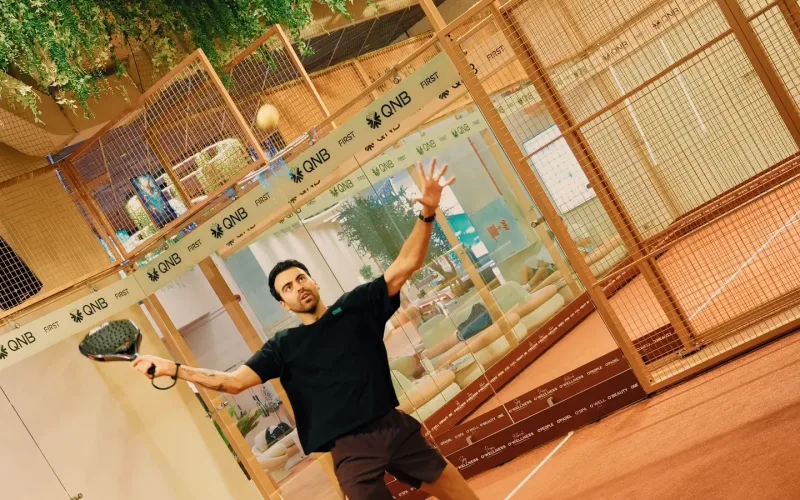
On an indoor court, the light fixtures can enter your field of view when you look up during lobs and smashes. In that case, rather than tracking the ball directly in front of the fixture, it can help to angle your head slightly and follow the ball’s trajectory to the side of the light source. Pointing at the ball with your free hand as you prepare for a smash makes it easier both to keep your balance and to track the ball’s position. For these techniques, see smash variations and bandeja guides.
Contrast: Separating the Ball from the Background
The second major factor affecting visibility is contrast. The more distinct the difference between the ball’s color and the walls, floor, ceiling and the area behind the court, the easier it is to follow the ball. Padel balls are usually yellow or yellow-green; these colors provide good contrast against a blue or green surface and dark backgrounds.
- Surface color: Blue or green artificial turf creates good contrast with a yellow ball.
- Background: Dark, plain walls and areas behind the court make the ball stand out.
- Glass surfaces: Clean, clear glass keeps the ball from blending into the background.
- Ball condition: New, brightly colored balls are easier to see than worn, faded ones.
For how ball choice and ball condition affect the game, you can read our choosing a padel ball article. Keeping balls fresh and properly pressurized helps with both visibility and consistency of play.
Clothing color and your opponent’s view
Some players believe the color of their clothing can have a small effect on visibility. Clothing in shades similar to the ball can briefly make it harder for an opponent to pick out the ball at the moment of the shot. However, this effect is limited and not a decisive factor in the game; your main focus should be improving your own vision.
Glass Surfaces and Reflections
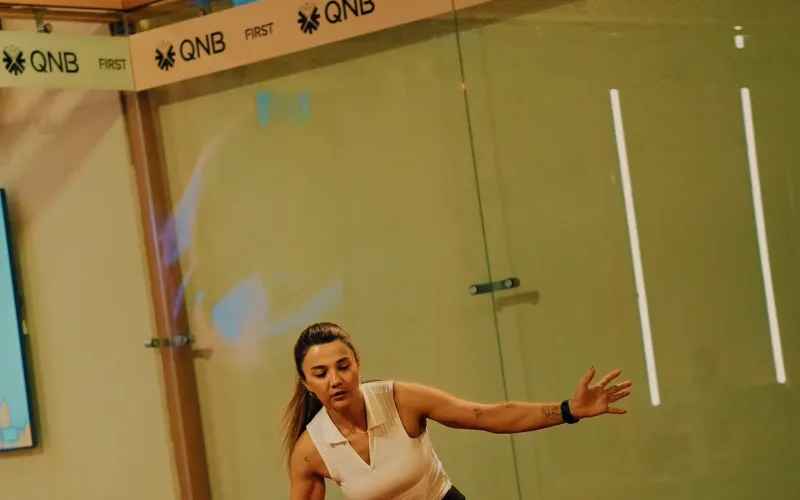
The tempered glass walls of padel courts are a fundamental part of the game, but glass surfaces can create reflections. Light reflecting off the glass can make it harder to track the ball, especially from certain angles. On a well-designed court, the lighting is positioned to minimize these reflections.
What you can do as a player is anticipate early where the ball will hit the glass and keep your eyes locked on its trajectory when reading balls coming off the wall. Wall-reading skills strengthen your game regardless of visibility conditions. On this topic, you can check out our using the walls in padel and contrapared guides.
Play with clear visibility on LED-lit indoor courts. Book your court at Skyland now.
Glasses, Contact Lenses and Protective Equipment
For players who need vision correction, padel raises some practical questions. Playing in everyday glasses can carry risks such as the glasses slipping, fogging up or breaking on impact. That is why it is important to discuss suitable options for sport with an eye doctor.
Options
- Contact lenses: Many players prefer contact lenses during sport because of the wide field of view and freedom of movement. You should check with your eye doctor whether contact lenses are right for you.
- Prescription sports glasses: Glasses designed for sport, with impact-resistant lenses and a secure-fitting frame, are a safer alternative to everyday glasses.
- Protective sports eyewear: Players who don’t need vision correction may also choose protective eyewear, especially against fast balls at the net.
Do you need sunglasses on an indoor court?
Because there is no sunlight on indoor, climate-controlled courts, sunglasses are generally unnecessary. In fact, dark-tinted glasses can reduce visibility indoors and make the ball harder to follow. When playing outdoors, however, sunglasses or a cap can help depending on the sun’s position; in that case, choose models designed for sport that fit securely and are impact-resistant.
Preventing fogging
One of the most common problems for players who wear glasses is fogging. Rising body heat during intense effort can cause the lenses to fog up. Ventilated frames, anti-fog coatings and a sweatband can help reduce this problem. Climate-controlled courts can also limit fogging by keeping temperature and humidity balanced. For more on protective equipment, see padel protective equipment guide.
If you have a vision problem, feel discomfort in your eyes or notice a sudden change in your vision during play, take a break and consult an eye doctor.
Improving Your Visual Tracking Skills
Good vision isn’t only about the environment and equipment; the ability to track the ball can also be trained. The impression that professional players “see the ball early” comes largely from their ability to read the opponent’s shot and predict the ball’s trajectory.
- Watch your opponent’s racket: Try to predict where the ball will go from your opponent’s racket angle and swing.
- Focus on the ball: Keep your eyes on the ball until contact; don’t lift your head early.
- Prepare with a split step: A well-timed split step lets you turn visual information into movement quickly. For details, see padel footwork post.
- Reaction drills: Quick volley exchanges with your partner at short range improve your reaction time.
- Wall-reading repetitions: Strengthen your trajectory prediction by returning balls off the glass again and again.
To develop your reaction skills in volleys and net play, our volley technique and net position articles offer practical drills.
Fatigue and concentration
Toward the end of long matches, visual tracking can decline as fatigue sets in. Getting enough sleep, staying hydrated and taking short breaks between games help you maintain concentration. On this topic, see padel hydration and padel recovery guide .
Evening Matches and the Indoor Court Advantage
In Istanbul, many players play in the evening after work. On outdoor courts, fading natural light and the switch to artificial lighting in the evening can change visibility conditions. On indoor courts, the lighting stays the same all day; a 06:00 morning match and a 22:00 evening match are played in the same visibility conditions.
This consistency matters especially for technical development. Playing regularly in the same conditions helps your visual tracking and timing skills develop more steadily. For morning players, Sunrise Padel sessions, and for evening players, courts open until 23:00 on weekdays offer options to suit different schedules. For reservation options, see our when making your court reservation page, and for technical development, our padel lessons page.
For first-timers on an indoor court
If you have only played on outdoor courts before, it may take a few sessions to get used to the visual conditions of an indoor court. In your first matches, notice where the lights are on high balls, observe the glass reflections and see how the ball looks against the background. Hitting a few lobs and smashes during the warm-up to get used to these conditions reduces errors in the opening games of the match. For a warm-up routine, see pre-padel warm-up article.
Vision for children and young players
Children and young players may take longer than adults to adjust to the speed of the ball and glass rebounds. That is why sending the ball slower and higher in kids’ lessons helps visual tracking skills develop gradually. Choosing sports glasses is also important for children who need vision correction; choose impact-resistant models that fit the child’s face properly, and always make the choice together with an eye doctor. For family play plans, see Sarıyer family sports guide.
Conclusion
Indoor court visibility is shaped by strong, evenly distributed lighting, good contrast, a court design that minimizes reflections and the player’s choice of the right equipment. Sunglasses are generally not needed on an indoor court; if you wear glasses or contact lenses, you should review suitable options for sport with your eye doctor. Located in the Skyland Istanbul complex in Sarıyer, O’Padel Sky’s indoor, FIP-standard courts with 500+ lux LED lighting offer players from Maslak, Levent, Ayazağa and Zekeriyaköy the same clear visibility from morning to night. With the O’Padel Sky coaching team, you can also develop your visual tracking and reaction skills step by step.
FAQ
Generally not. Dark-tinted glasses can reduce visibility indoors. On outdoor courts, models designed for sport may be a good choice depending on the sun’s position.
Everyday glasses can break on impact. We recommend reviewing suitable prescription sports glasses or contact lens options with an eye doctor.
The courts use 500+ lux LED lighting, which provides consistent visibility from morning to night.
Watching your opponent’s racket movement, preparing with a split step and doing wall-reading drills will improve your visual tracking skills.


 Padel Courts
