
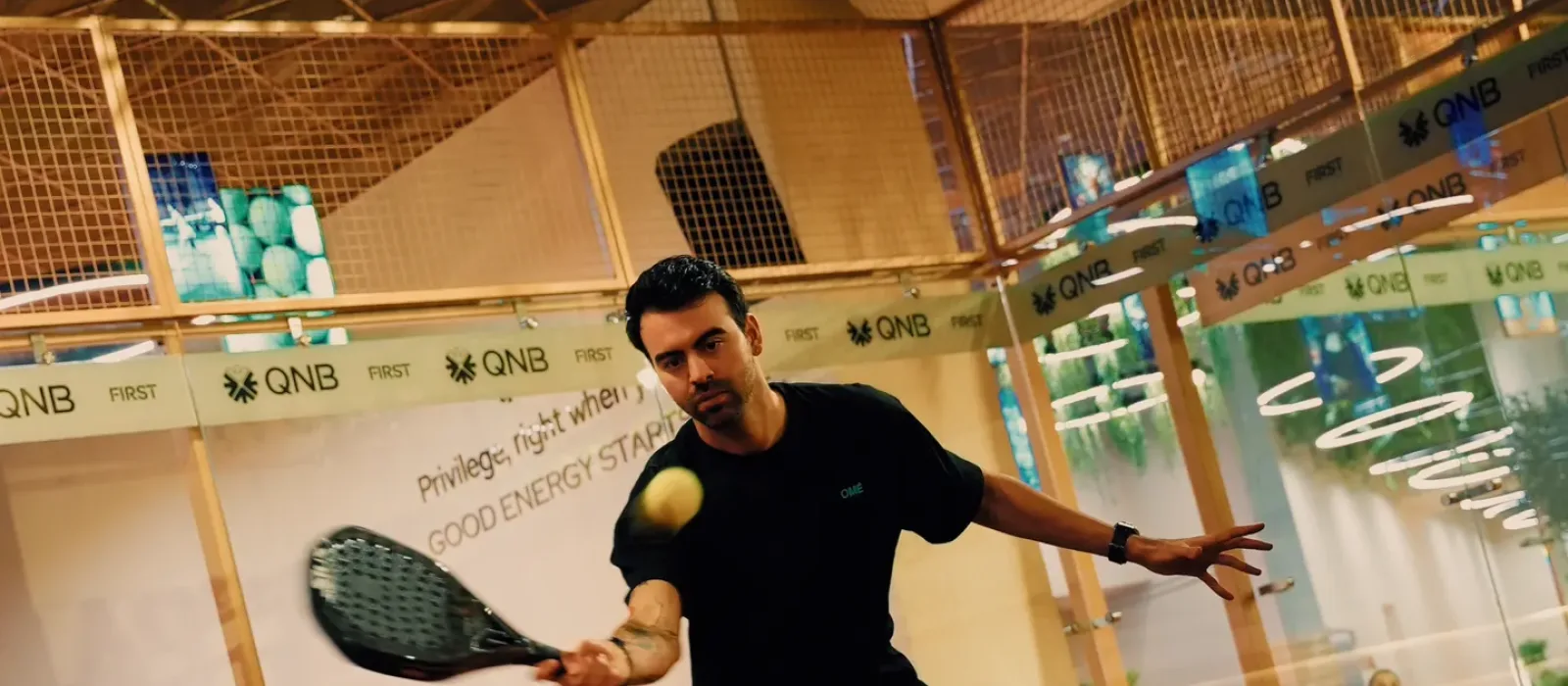
Contrapared (counter-wall) is a recovery shot in which the player hits the ball into the glass wall on their own side, usually the back glass, so that it rebounds off the wall and travels over the net into the opponent’s court. If the ball has gotten past you, is very close to the back wall or has you pinned in the corner, and you have no chance of replying with a conventional shot, the contrapared is one of the last resorts for keeping the rally alive. It is legal; as long as the ball has bounced no more than once on your side, you can use your own wall.
In this guide, the O’Padel Sky coaching team explains when to use the contrapared, how to execute it technically, common mistakes, safety points and how to practice this shot progressively. Remember: although the contrapared looks flashy, its real purpose is to save the rally, not to produce a winner.
Summary
- The contrapared means hitting the ball into your own wall and sending it from the wall into the opponent’s court.
- It is a defensive/recovery shot used when the ball has gotten past you and a conventional shot is no longer possible.
- The ball must have bounced no more than once on your side; then you can hit it into your own wall.
- It requires a high arc and enough power; otherwise the ball drops short of the net.
- Controlled power, a short backswing and the right angle are the keys to success.
What Is the Contrapared, and Is It Legal?
One of the biggest differences between padel and tennis is that the walls are part of the game. After your opponent’s shot, the ball can bounce once on your side and hit the wall, and you can play it after it comes off the wall. The contrapared is the reverse: the wall comes into play after your shot. You hit the ball, it strikes your own back or side glass and from there travels over the net into the opponent’s court.
Under the rules, the ball is allowed to hit the wall on your own side before crossing the net. What matters is that the ball has not bounced twice on your side and that, after your shot, it reaches the opponent’s court over the net without touching the ground. For details of the glass and fence rules, see padel glass and fencing rules and complete guide to padel rules .
Types of contrapared
- Back glass contrapared: The most common type; the ball is hit into the back glass and clears the net with a high arc.
- Side glass contrapared: When you are pinned in the corner, the ball is hit into the side glass and directed crosscourt.
- Corner contrapared: A more difficult variation in which the ball touches both the back and side glass.
When Should You Use the Contrapared?
The contrapared is a last resort, not a first choice. If you can reply with a regular shot, a shot after the ball comes off the wall, or a lob, those options are always more reliable. You should consider the contrapared in these situations:
- The ball barely comes off the back glass and won’t come out in front of you.
- The ball has landed very close to the back glass and you can’t get your racket between the ball and the glass.
- Your opponent’s lob has gotten past you, and by the time you reach the ball you no longer have an angle to hit toward the net.
- You are pinned in the corner and there isn’t enough room to send the ball directly into the opponent’s court.
Most of these situations usually stem from a positioning or reading error. In other words, the way to need the contrapared less is how to use the walls and footwork improving. Still, even the best players have to rely on this shot from time to time.
Technique: Contrapared Step by Step
The contrapared technique differs from regular groundstrokes. Instead of sending the ball forward, you need to send it backward and upward. The steps below describe a back-glass contrapared for a right-handed player; if you're left-handed, simply reverse the directions.
| Stage | What to do | Key point |
|---|---|---|
| 1. Reading | Recognize early that the ball will stay close to the glass | Waiting until the last moment for a regular shot costs you time |
| 2. Positioning | Turn your body toward the glass and keep the ball at your side | Leave a safe distance so you don't hit the glass |
| 3. Racket face | Keep the racket face slightly open | Helps the ball rise upward |
| 4. Stroke | Short backswing, low-to-high swing | You need to hit the glass high enough and with enough power |
| 5. Recovery | Turn quickly toward the net and get into position | Your opponent will usually respond with an attack |
Angle and height
The most critical element of the contrapared is the arc of the ball as it comes off the glass. If the ball hits the glass too low, the arc is too short and it drops before the net. Sending it to a high enough point on the glass with an upward swing lets the ball clear the net comfortably. The target point depends on your court position and your distance from the ball, so this feel only develops through repetition.
Power control
The distance from the back glass to the net is about 10 meters, so the ball needs enough power to cover it. However, too much power ruins control and can send the ball out of the court or toward the ceiling. A controlled stroke combined with a short, quick wrist action gives you both enough power and the right direction. To improve your racket control, padel racket grip post.
Want to try the contrapared in a safe setting with a coach? Book your court.
Tactics After the Contrapared
A ball returned with a contrapared is usually high and slow, which gives your opponent a chance to attack. If your opponent is at the net, they'll likely respond with a smash or a bandeja. That's why you need to get back into a defensive position quickly after the shot and be ready together with your partner.
- Aim for a high arc: A higher, deeper ball makes it harder for your opponent to hit an aggressive smash.
- Tell your partner: When you play a contrapared, your partner can take up a defensive position in advance.
- Prepare to defend: Be ready to read your opponent’s smash as it comes off the glass.
- Plan the next ball: At the next opportunity, aim to win back the net with a lob.
For defensive tactics, see padel defense tactics and to win back the net, see lob technique articles.
Common Mistakes
Because the contrapared is a difficult shot, mistakes are common. These are the errors our coaching team sees most often.
- Deciding too late: Waiting in hope of a regular shot and running out of time.
- Hitting the glass too low: Causes the ball to drop before the net.
- Too much power: Costs you control, and the ball may go out of the court.
- Getting too close to the glass: Creates a risk of impact for both your racket and your body.
- Stopping after the shot: Getting caught unprepared for your opponent's attack.
- Using it unnecessarily: Resorting to the contrapared when a regular shot is possible.
Safety and Health
Safety is especially important in the contrapared because you're moving close to the glass wall. Always leave some distance so your racket and hand don't hit the glass. Using your racket's wrist strap reduces the risk of the racket slipping out of your hand. Remember that your partner may also be near the glass; communicating, especially on corner balls, prevents collisions.
This shot requires sudden trunk rotation and shoulder movement. If you have shoulder or elbow problems, we recommend you consult your doctor or a sports physiotherapist before practicing the contrapared intensively. Our article on shoulder injuries in padel offers more information. You can get support from a sports physiotherapist at O’Athletic Sky at Skyland Istanbul.
How to Practice the Contrapared
To use the contrapared confidently in a match, you first need to practice it in a controlled setting. The progressive plan below is the approach our coaching team uses in lessons.
- Hand-fed drops: Stand close to the back glass, drop the ball yourself, and feel the arc by hitting it gently against the glass.
- Adjusting the height: Hit the glass at different heights and watch where the ball crosses the net.
- Partner feeding: Have a partner or coach send balls that land close to the back glass.
- Decision drill: Quickly decide between a regular shot and a contrapared based on the incoming ball.
- Match simulation: Include the recovery to a defensive position after the contrapared.
It's natural to struggle to get the ball over the net in your first attempts. This shot requires your sense of timing and angle to settle in. Short, regular repetitions are more effective than long, exhausting sessions. Because the bounce is more consistent on indoor, climate-controlled courts, technical work like this is more productive there; to learn how indoor courts affect the game, tactical differences between outdoor and indoor courts article.
At what level should you learn it?
The contrapared is an advanced technique to work on once your basic groundstrokes and use of the walls are solid. It's generally suitable for players who have reached an intermediate level. If you're just starting out, we recommend focusing first on basic shots and handling balls off the walls. To find out your level, padel level assessment see our article; to plan your technical development, padel lessons page.
For intermediate players, learning the contrapared means adding an important tool to your defensive repertoire. Being able to return balls you used to lose shakes your opponent's confidence and extends the rally, creating new opportunities for you. Still, the less you need this shot, the better your positioning; so always pair contrapared practice with wall-reading and footwork drills.
You can set a simple goal to measure your progress: for example, track how many out of ten balls fed by your coach you can get over the net. As this ratio rises over time, you'll know you're ready to try the shot in match play. In league and tournament matches, using the contrapared only when it's truly necessary helps you avoid giving away needless points. To prepare for tournament play, tournaments and leagues page.
Contrapared coordination in doubles
Because padel is a doubles game, the decision to play a contrapared affects not only you but also your partner. If it's unclear which player will take a ball heading to the back corner, both players may go for the glass at the same time; this leads both to lost points and to a risk of collision. That's why short, clear calls are important on corner balls.
While the player going for the ball calls “mine,” their partner should immediately move into a defensive position and prepare to handle the opponent's attack on the high ball coming back from the contrapared. Practicing this scenario with your partner in training builds instinctive coordination during matches. To clarify roles at the baseline, right and left player roles our article can also guide you.
Remember, the value of a good contrapared only shows through the quality of the defense that follows. When you move together as a pair, a saved ball can turn the rally around completely.
Finally, practicing the contrapared in the first half of a session, when you're warmed up and highly focused rather than tired, both speeds up technical learning and increases safety when moving near the glass.
Conclusion
The contrapared is one of the most interesting examples of padel's wall culture: it lets you keep a seemingly lost ball in play by using your own glass. Executed at the right time, with the right angle and controlled power, it strengthens your defense; but the real goal is to need this shot less through good positioning. At O’Padel Sky, located in the Skyland Istanbul complex in Sarıyer, you can practice the contrapared safely and progressively with the O’Padel Sky coaching team on indoor, FIP-standard courts with 12 mm tempered glass.
FAQ
Yes. The ball is allowed to hit the back or side glass on your own side before crossing the net into the opponent's court, as long as it hasn't bounced twice on your side before the shot.
Basic shots and handling balls off the walls should be solid first. The contrapared is generally recommended for players who have reached an intermediate level.
Although it's occasionally possible, the main goal is to keep the rally going. Since the returned ball is usually high and slow, it can give your opponent a chance to attack.


 Padel Courts
