
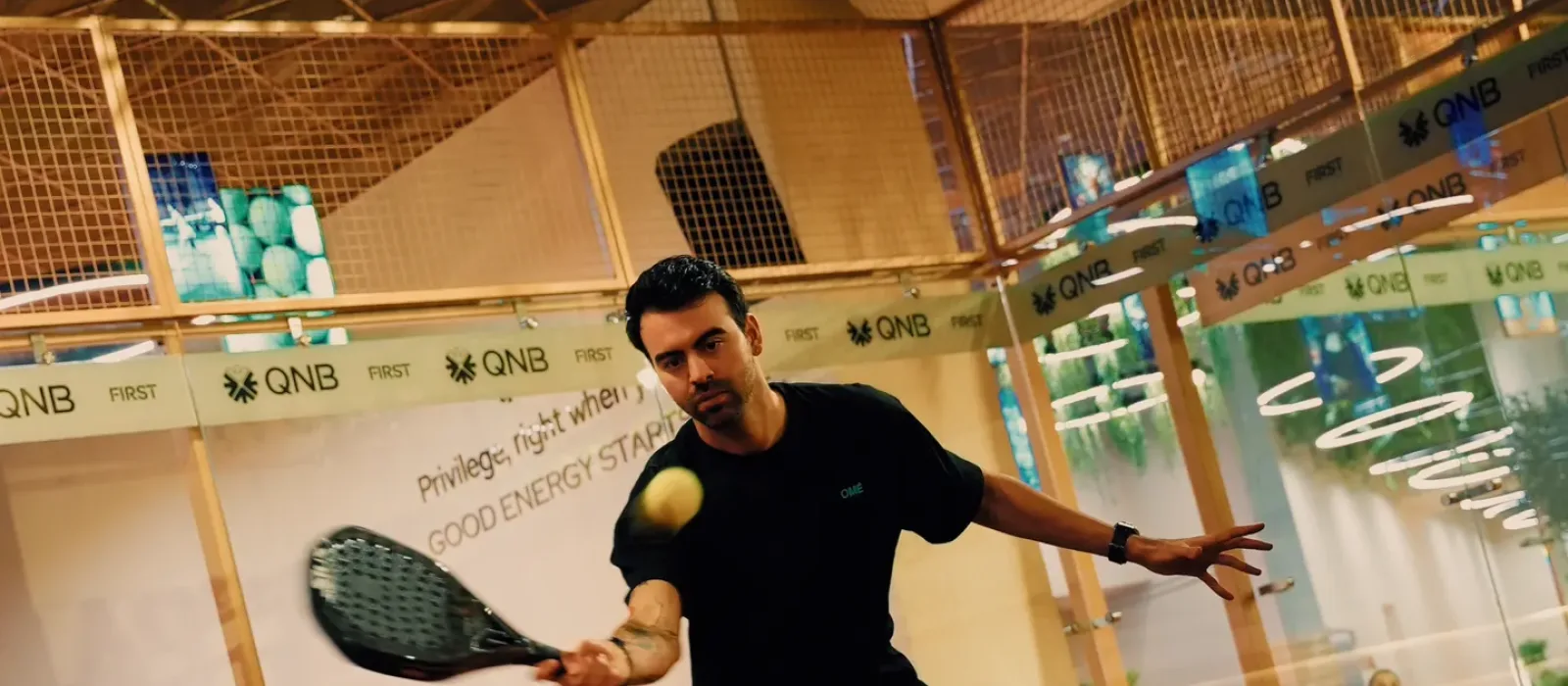
The por tresis a powerful type of smash in padel that bounces the ball in the opponent's half and sends it out of the court over the side wall or through the side exits. Its name comes from the ball leaving the court via the “third” direction, that is, from the sides; a smash where the ball goes out over the back wall is known as a “por cuatro.” When executed correctly, it is extremely hard for the opponent to return, so it is usually a shot that wins the point outright.
In this guide, the O’Padel Sky coaching team explains what the remate por tres is, when it should be attempted, its technical steps, points to watch from a rules perspective, safety and shoulder health, and how you can practice this shot progressively. The por tres is a spectacular shot, but attempted at the wrong moment it can also hand your opponent an easy point.
Summary
- The por tres is a smash that bounces the ball in the opponent's half and sends it out of the court over the side wall.
- The difference from the por cuatro is that the ball leaves the court from the side rather than the back.
- It should be attempted near the net when a high, short lob comes.
- Angle and the ball's bounce point are as decisive as power.
- Watch your shoulder load; if you have pain, consult your doctor.
What Is a Por Tres, and How Is It Different from a Por Cuatro?
In padel, smashes generally serve three purposes: pushing the opponent back, sending the ball into open space, or finishing the point by putting the ball out of the court. The por tres and por cuatro fall into this last category. In both, the ball hits the ground in the opponent's half, then bounces off the wall and out of the court.
| Shot | Ball exit direction | Key feature |
|---|---|---|
| The por tres | Over the side wall or through the side exits | Angled shot; the ball shoots sideways after the bounce |
| Por cuatro | Over the back wall (and fence) | Flat, very powerful shot with a high bounce |
| Víbora / bandeja | Stays inside the court | Focused on control and position; builds pressure rather than finishing the point |
The basic idea of the por tres is to hit the ball powerfully and at an angle toward the side of the opponent's half. After hitting the ground, the ball strikes the side glass and leaves the court over the side wall or through the side exits. For a general overview of smash types, see smash variations guide.
The Por Tres and the Rules
If the ball bounces in the opponent's half and leaves the court before the opponent can touch it, the point goes to the hitter. However, on some courts, the design of the side exit areas and the event rules may allow the opponent to run outside the court and return the ball into play. This “playing outside” situation depends on the court's architecture and the tournament or club rules in effect.
For that reason, it's important to clarify before a match, especially in tournaments, whether playing outside the court is allowed. For rules on shots played outside the court, see our article on the outside-the-court shot rule , and for general rules, complete guide to padel rules post.
When Should You Try a Por Tres?
The por tres isn't a shot for every high ball. Certain conditions increase the chance of success, and por tres attempts made without them usually end in an easy counterattack.
- Close to the net: You should be near the net, in front of the service line; a por tres hit from deep has a lower chance of success.
- Short, high lob: If your opponent's lob lands short and you can comfortably get under the ball, it's an ideal opportunity.
- Balanced position: Your feet should be set and your body under the ball; don't attempt it while running or backpedaling.
- Room for an angle: If the ball is near the side of the court, creating an angle is easier.
- Opponents' position: It's more effective if your opponents are near the back glass and far from the side exits.
If these conditions aren't met, the safer option is to keep up the pressure with a bandeja or víbora and wait for a better opportunity. For these shots, you can read our how to hit a bandeja and víbora technique guides.
Technique: The Por Tres Step by Step
The steps below describe a por tres hit on the forehand side by a right-handed player. If you're left-handed, simply reverse the directions.
- Early preparation: As soon as you see the lob, turn your body sideways so your left shoulder faces the net.
- Positioning: Use your footwork to get slightly in front of and under the ball; set the distance so you can hit it above your head and slightly in front.
- Arm preparation: Point at the ball with your left arm; this supports both balance and timing.
- Contact point: Meet the ball at the highest point you can reach, in front of your body.
- Angle: Aim the racket face to send the ball to the area of the opponent's half near the side glass.
- Wrist and follow-through: Add speed to the ball with a wrist snap at contact; complete the follow-through with control.
- Landing and recovery: Land balanced and, if the ball comes back, get into the ready position immediately.
Footwork is the foundation of this shot; failing to get under the ball at the right time is the most common reason for failure. For the technique of retreating against a lob, see padel footwork our guide.
The ball's bounce point
The success of a por tres depends largely on where the ball lands in the opponent's half. The ball should land close enough to the side glass, within the service box, at an angle toward the side glass. A ball that lands too central can't reach the side glass with enough speed; a ball that lands too deep comes back off the back wall and gives the opponent a chance to respond. A feel for this bounce point only develops through repetition and observation.
Power or angle?
New learners usually try to pull off the por tres with power alone. But if the angle and bounce point aren't right, even the most powerful shot stays inside the court. A good por tres is the result of the right angle combined with enough power. Learn the angle and bounce point first, then increase power gradually.
Want to practice the por tres with a coach? Book your court and take your smash to the next level.
Common Mistakes and Risks
When a por tres fails, it gives the opponent an easy opportunity. The ball stays in the court, comes back high, and the opponent returns it from a comfortable position. That's why it's important to recognize the mistakes.
- Attempting it at the wrong time: Forcing a por tres from deep or from an unbalanced position.
- Relying on power alone: A powerful shot without an angle stays in the court.
- Getting under the ball late: The contact point ends up behind you and you lose control.
- Aiming for the center: The ball doesn't reach the side glass.
- Stopping after the shot: Being caught unprepared if the ball comes back.
- Trying it on every high ball: Your opponent reads it and chooses different shots instead of lobbing.
For choosing the right shot when attacking, see padel attacking tactics .
Shoulder Health and Safety
The por tres requires a powerful movement from the shoulder and trunk rotation. Repeated powerful smashes can place load on the shoulder and elbow, especially if your warm-up is insufficient or your technique is flawed. That's why it's important to warm up the shoulder area thoroughly before practicing the por tres.
If you have shoulder, elbow or lower back pain, consult your doctor or a sports physiotherapist before starting powerful smash practice. On this topic, our articles on shoulder injuries in padel and tennis elbow offer additional information. O’Athletic Sky at Skyland Istanbul lets you work on shoulder strength and mobility with expert support.
Since the ball leaves the court on a por tres, it's also important to watch out for people around the court. During practice, keeping the area where the ball will go clear and warning those nearby is a good habit.
How to Practice the Por Tres
To use the por tres confidently in a match, you first need repetition in a controlled setting. Here is the progressive approach our coaching team uses in lessons.
- Shadow swings: Repeat the preparation, contact and follow-through without a ball.
- Easy feeds: Have the coach send high, short lobs near the net; focus only on the angle at first.
- Target zone: Set a target near the side glass in the opponent's half and try to land the ball in that area.
- Building power: As your angle becomes consistent, increase power gradually.
- Decision drill: On different lobs, decide between a bandeja, víbora or por tres.
- Match simulation: Also practice recovering if the ball comes back after a por tres.
On indoor, climate-controlled courts there's no wind, so the ball's trajectory is more predictable, which makes smash practice more efficient. To learn more on this topic, see tactical differences between outdoor and indoor courts article.
At what level should you learn it?
The por tres is an advanced technique. Moving on to it before your bandeja and basic smash are solid is risky both technically and physically. It's usually added to the repertoire of intermediate and advanced players. To find out your level, see our article padel level assessment , and for an individual training plan, padel lessons page.
Before using the por tres in tournament and league matches, it's important to build enough confidence in practice. Since technique can break down under match pressure, take the shot into matches only once you can execute it consistently in training. For a competitive setting, see tournaments and leagues page.
Defending against your opponent's por tres
Knowing how to defend against the por tres is as important as learning it. When you see that your opponent is near the net and balanced under the ball, positioning yourself near the side exits and being ready to read the ball's rebound off the side glass improves your chances. The most effective defense, however, is not giving away short lobs; deep, high lobs make it harder for your opponent to attempt a por tres. To improve your lob quality, see lob technique .
Coordinating with your partner
A por tres attempt is not just your shot; it's part of the attacking setup you build as a pair. While you get under the ball for the smash, your partner should hold their position at the net and stay ready in case the ball comes back. If the por tres fails and the ball stays in the court, the opponent's reply usually comes fast and low; at that moment, your partner being ready to volley can save the point.
You should have a clear agreement on which player takes the lob. Usually the player who can smash on the forehand side takes the ball, but this rule can vary depending on the pair's playing style. A short conversation before the match prevents both players from going for the same ball. Our article on who takes the middle balls, whose ball is the middle ball and our article on communication, partner communication can guide you.
Also, observing which player on the opposing team tends to leave their lobs shorter lets you anticipate por tres opportunities. Opponent analysis is valuable in this respect as well.
Conclusion
The remate por tres is one of padel's most impressive finishing shots; executed under the right conditions and at the right angle, it leaves the opponent almost no chance. True mastery, however, lies in knowing when not to attempt it. On the FIP-standard indoor courts of O’Padel Sky, located in the Skyland Istanbul complex in Sarıyer, you can practice the por tres step by step with the O’Padel Sky coaching team, and prepare your shoulder strength and mobility for this shot at O’Athletic Sky.
FAQ
In a por tres, after bouncing in the opponent's half, the ball leaves the court over the side wall or through the side exits; in a por cuatro, it goes out over the back wall.
It depends on the court's architecture and the tournament or club rules in effect. It's best to clarify before the match whether playing outside the court is allowed.
Power matters, but it isn't enough on its own. Without the right angle and bounce point, even powerful shots can stay in the court.
If you have pain, you should consult your doctor or a sports physiotherapist before starting powerful smash practice.



 Padel Courts
