
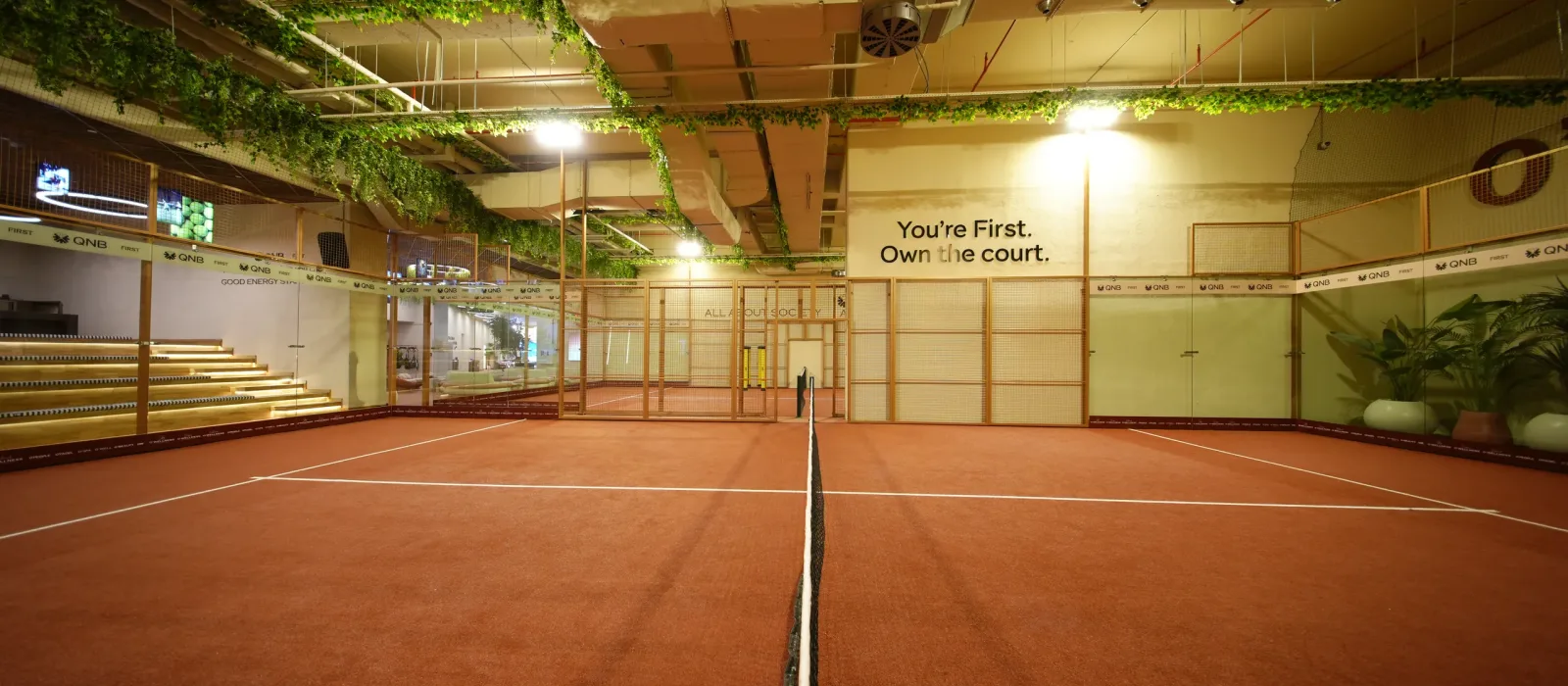
The padel out-of-court rule says this: if the ball bounces once validly on the opponent's side and then goes over the walls surrounding the court, the point doesn't end right away. If the facility's physical layout allows it, a player can exit through the door and return the ball from outside the court before its second bounce. If the ball clears the net and lands on the opponent's side, the point continues and the shot is completely legal.
This rule is one of the most dramatic details that sets padel apart from other racket sports. Those scenes you see in pro matches, where a player leaves the court and chases down the ball outside, are based exactly on this. Below, as the O’Padel Sky coaching team, we break down the conditions for an out-of-court shot under the official FIP rules framework, valid and invalid scenarios, door use, and how to apply it in club matches. If you want to see the full rules, complete guide to padel rules is a good place to start.
Summary
- The ball must first bounce on the opponent's side; if it then goes over the walls, the player can play it outside.
- The shot must be made before the ball bounces a second time. The second bounce ends the point.
- A player leaves the court only if the structure allows it; on indoor courts this often isn't possible.
- The returned ball must clear the net and land on the opponent's side; if it hits the net or the post, the point is lost.
- This right doesn't apply on serves or balls that hit the wall directly.
The logic behind the out-of-court shot rule
A padel court is 20×10 meters and enclosed on all four sides. The glass and metal fencing are there to keep the ball in play, but the ball going over the walls isn't forbidden. The rulemakers draw a simple distinction here: it's enough that the ball made a valid first bounce on the opponent's side. The moment that bounce happens, the shot already counts as valid; wherever the ball goes afterward doesn't automatically end the point.
So a ball that goes out isn't “dead,” just hard to reach. If the defending team can get to it, they have the right to keep playing. For more detail on how the walls behave, see the padel glass and fencing rules article; its “ground first, then wall” principle is also the foundation of this rule.
Three conditions for a valid out-of-court shot
For an out-of-court shot to count, three things must be true at the same time:
- A valid first bounce. The ball must have touched the ground once within the boundaries of the opponent's side. A ball that goes straight out without touching the ground is a fault for the hitting team.
- Contact before the second bounce. The player must hit the ball before it touches the ground a second time outside. Bouncing on the outside surface doesn't change the rule; what counts is the total number of bounces.
- A valid return. The ball must clear the net and land on the opponent's side. Getting stuck in the net, catching the post, or not reaching the opponent's side counts as a fault.
If any of these three conditions is missing, the point goes to the other team. The rule gives you an extra chance, not extra leeway.
How do you leave the court? The door rule
A player can leave the court only where the court structure allows, meaning through the door opening. Jumping over the glass or fencing, or climbing the wire mesh, isn't a valid way to exit during play. The door is in the middle of each side wall, near the net line, and the dimensions of this opening are standardized in tournament regulations.
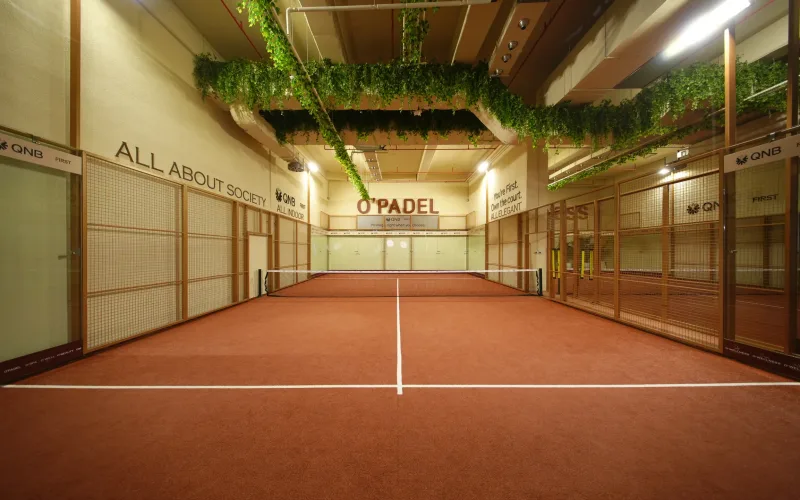
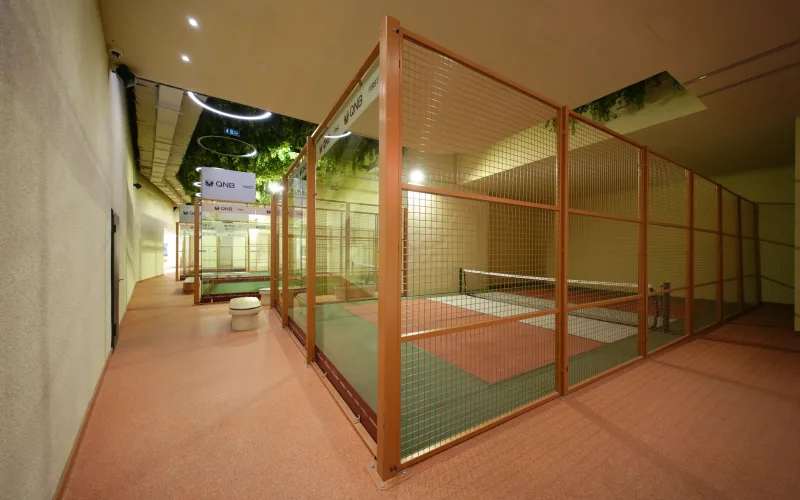
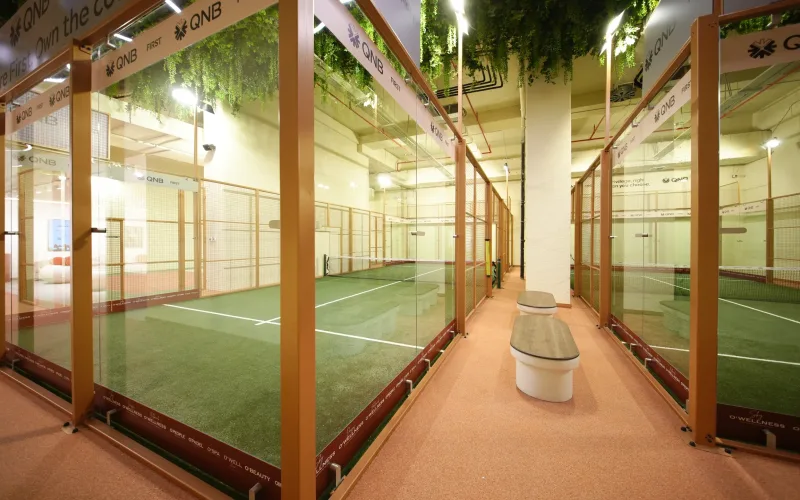
At some facilities, the doors are kept closed during play, or there's no free playable space around the court. In that case, the rule exists in theory but can't be applied in practice. On indoor, climate-controlled courts with side-by-side courts, going outside usually isn't possible; at indoor facilities like O’Padel Sky, players almost never face this scenario. That's why the first thing to do in club matches is to agree at the start whether the outside area is playable.
Valid or invalid? Scenario table
| Scenario | Conclusion | Why |
|---|---|---|
| The ball bounced on court, then went over the glass; the player exited through the door, hit it before the second bounce, and the ball landed on the other side | Legal, play continues | All three conditions were met |
| The ball bounced in the court and went out, the player hit it, but it caught the net | Point lost | Return not valid |
| The ball went straight out over the walls without touching the ground | The hitting team loses the point | No valid first bounce |
| The ball was hit after bouncing a second time outside | Point lost | The second bounce ended the point |
| The player climbed over the glass to get out | Invalid | Exit must be through the door |
| The serve bounced in the court and went out | Counts as a service fault | Separate, stricter rules apply to the serve |
| The ball bounced, hit the fence, then went out; the player played it outside | Generally valid | First bounce occurred, bounce count not exceeded |
Every distinction in the table comes down to one question: did the ball legally bounce once in the opponent's court? If the answer is “yes,” play can continue.
The serve and out-of-court play: why the exception?
The serve is the most tightly constrained shot in padel. The ball must land in the diagonal service box, and if it goes into the metal fence or out of the court after landing in the box, it's a service fault. In other words, the serve gives no right to “play the ball outside”; normal play only begins once the first or second serve is valid. For details on the service framework, see padel serving rules .
The exception makes sense: the serve starts the point and is expected to be controlled. Once play is flowing, the rule becomes much more flexible.
Out-of-court balls, glass bounces and defensive positions click much faster once you try them on court. Pick your time at our indoor courts at Skyland Istanbul and practice with our coach.
Out-of-court balls from a tactical angle
Knowing the rule pays off tactically. A shot that sends your opponent out of the court may leave them a chance to win the point, but it pulls them away from the playing area. When an opponent goes outside, both players' positions break down; the defensive line suddenly drops to one person.
- If you're the one going outside: send the ball back as high as possible, with a globo. Your goal isn't to win the point but to buy time to get back into your court.
- If your partner went outside: slide to the middle of the court, cover the wide space and communicate out loud. Clear calls are critical at this point; padel partner communication the call patterns in this article come in handy.
- If you sent your opponent outside: stay at the net and use the open space with a short, tight-angled shot. Controlled placement is safer than a rushed smash.
- Reading the double bounce off the side glass: balls coming off the corners most often exit from this area. Corner reading transitioning from defense to attack develops along with your skills.
Practical application in club matches
In club matches played without a referee, this rule is one of the most disputed, because whether the ball bounced is usually judged by a single player's eye. The established practice in padel is that each team is responsible for calls on the ball on its own side. When in doubt, replaying the point is the best solution. For how to handle disagreements, see fair play in unrefereed matches article.
In tournaments, the organizing committee specifies before the match whether the outside area may be used. In fast formats like Americano and Mexicano, time is limited, so some organizers disallow playing outside entirely. For how the formats work, see What is Americano article.
Three common mistakes
First, giving up on every ball that goes out. Players miss a playable ball because they don't know the rule. Second, the opposite: running outside to hit when there was no valid first bounce, not realizing they had already won the point. Third, trying to go over the glass instead of through the door; that's both invalid and a high injury risk.
The common cause of all three mistakes is panic. When you make a habit of focusing on where the first bounce happened rather than following where the ball is going, the right decisions come naturally. If you're curious how the rules compare with other sports, padel vs tennis rule differences shows this difference well.
Four steps to reading an out-of-court ball
Knowing the rule isn't enough; you need to see early that the ball is going out. Here is the sequence our coaching team uses in lessons.
1. Watch your opponent's contact. Whether the ball will go out is clear the moment it's struck. A hard, downward smash aimed at the glass will most likely rise off the back glass and go out. That's why it pays to focus not just on the ball but on your opponent's racket angle.
2. Confirm where the first bounce is. Did the ball touch the ground, and if so, was it inside the lines? This one question decides everything else. If there's no bounce, you don't need to run; the point is already yours.
3. Gauge the distance to the door. The door is in line with the net; if you're defending at the back of the court, you take a diagonal path from the corner to reach it. If the distance is more than two steps, going outside rarely makes sense.
4. Choose your shot in advance. If you decide to go out, know what you'll hit beforehand: a high, deep globo down the middle. Improvising outside almost always turns into an error. You'll see the reason for this choice in padel tactics guide in the defensive hierarchy section of the article.
When should you try it, by level?
The out-of-court shot is one of the flashiest yet riskiest moves in padel. The right time to try it depends on your level.
- 1.0–2.5: Don't try it. The focus should be on reading the valid bounce and taking the right position in the back court. Level assessment defines this range in detail.
- 3.0–3.5: Only if the door is right next to you and the ball is slow. Your goal isn't to save the point but to get comfortable with the move safely.
- 4.0–4.5: Can be used regularly. At this level, globo quality can be maintained even from outside.
- 5.0 and above: Now a tactical option. Some players deliberately play into the side glass corner to pull the opponent out of the court.
Physical preparation also matters: going outside involves sudden changes of direction and lateral acceleration. Trying this move without warming up increases adductor and ankle risks; pre-match warm-up we recommend not skipping your routine.
Conclusion: At Skyland, rules knowledge turns into points
The out-of-court shot rule is the most concrete proof of padel's “it's not over until the ball is dead” philosophy. Although going outside often isn't possible on our indoor courts at Skyland Istanbul in Sarıyer, the logic behind the rule — the valid first bounce and the bounce count — applies to every point. In lessons with our players from Maslak, Ayazağa and Zekeriyaköy, we work on this reading from the very first week; our padel lessons are open to join, or you can our courts browse and make your reservation today.
FAQ
No. The rule allows it, but applying it requires open space around the court and a door that opens. With indoor courts placed side by side, this is usually physically impossible; the most practical solution is to clarify it with your partner before the match.
The rule doesn't force you to return within a set time, but you need to be on court to play the next ball. That's why a shot from outside is almost always best as a high, deep globo; the seconds you gain make your return possible.
Once the ball touches a fixed obstacle or person outside the playing area, it is no longer considered playable and the point goes to the team that sent the ball out. In club matches, replaying the point in such situations is also a common and accepted solution.
The rule allows players to leave the court, but only one player may hit the ball. Having both players outside on the same point is a big tactical risk because the court is left completely empty; in practice, the player closest to the ball goes out while the other covers the middle.
Yes, the rule makes no distinction by level. But our advice for beginners is to first learn to read the valid bounce and settle into a basic defensive position. Out-of-court shots develop naturally at an advanced level; forcing them early increases injury risk.


 Padel Courts
