
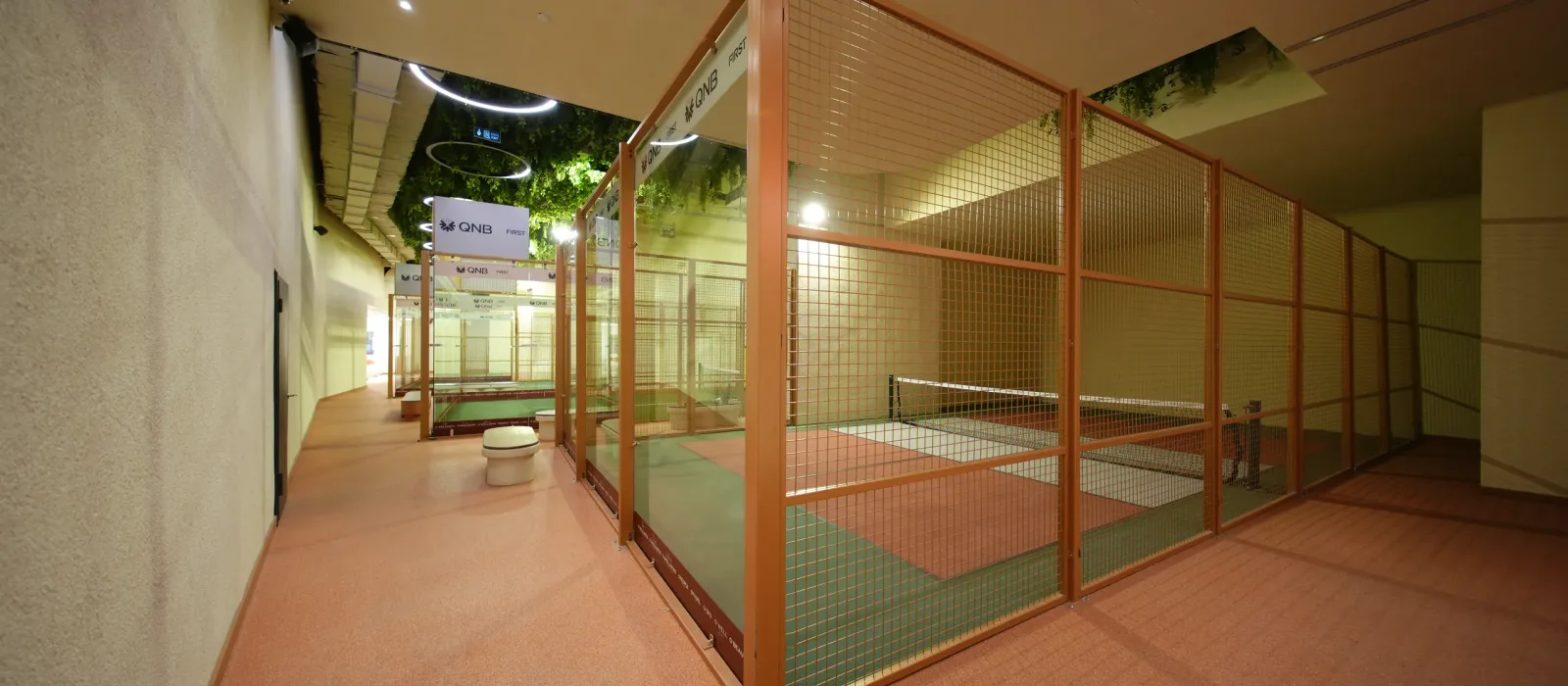
Padel court standards are technical rules that define every element affecting the playing area, including court dimensions, wall and glass structure, net height, surface type, lighting and ceiling height. The International Padel Federation (FIP) rulebook sets the basic framework for official play: interior dimensions of 20×10 meters, a net about 88 cm high in the center, and an enclosed area surrounded by glass and wire mesh. Thanks to these standards, a shot you learn in Istanbul can be played the same way on a court in another city. They ensure players have a similar playing experience no matter which court they play on.
In this article, the O’Padel Sky coaching team looks at padel court standards from a player's perspective: Which dimensions matter, why do glass and surface make a difference, how does lighting affect play, and how can you judge a court's quality on court? Let's also note from the start that current federation documents should be used as the reference for the full details of technical specifications.
Basic Dimensions: 20×10 Meters and the Net
A padel court is a rectangular area with interior dimensions of 20 meters long and 10 meters wide. In the middle of the court is a net that divides it into two equal halves. The net is about 88 cm high in the center and about 92 cm at the sides. This small difference in height comes from the natural shape of the net as it's tensioned toward the sides.
On each half of the court, the service line is about 6.95 meters from the net, leaving an area of about 3 meters between this line and the back wall. The center service line divides the service area into two equal boxes. For a detailed explanation of the dimensions, padel court dimensions and structure post.
| Element | Standard value (approx.) | Effect on play |
|---|---|---|
| Interior dimensions | 20 m × 10 m | Consistent playing area on every court |
| Net height | 88 cm in the center, 92 cm at the sides | Difficulty of cross-court and down-the-line shots |
| Service line | 6.95 m from the net | Depth of the service area |
| Service line – back wall | About 3 m | Room to move in the back zone |
Walls: Glass and Wire Mesh
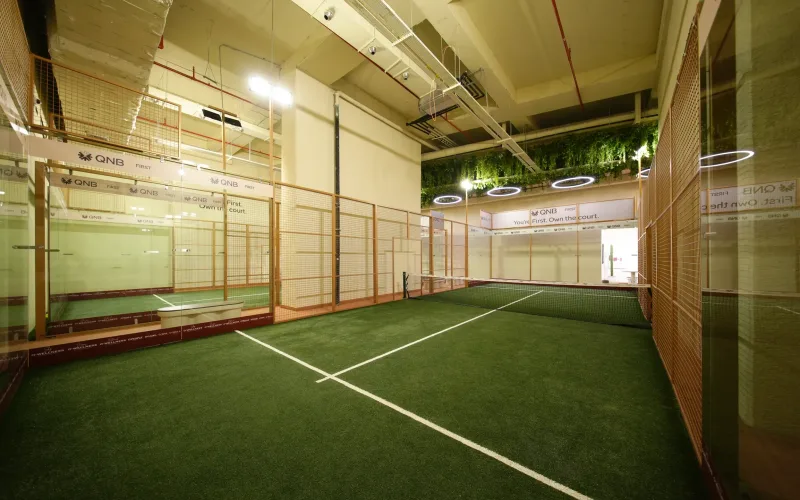
The most important element that sets padel apart from other racket sports is the walls surrounding the court. The back walls and the rear sections of the side walls are usually made of tempered glass, while the other sections are metal wire mesh. The glass sections are part of the game: if the ball hits the glass after bouncing on the opponent's side, play continues. Wire mesh has a different bounce character; the ball comes off the mesh more irregularly and unpredictably.
Why does glass quality matter?
Tempered glass is critical for both safety and quality of play. Glass of sufficient thickness ensures the ball bounces consistently and predictably. With thinner or poorly installed glass, the ball can come back at a different speed and angle than expected, which makes reading the walls harder. Especially for beginners, a consistent glass bounce makes learning to use the walls much easier; a ball that comes back differently every time makes it almost impossible to learn proper timing. Different glass thicknesses may be used on courts; the courts at O’Padel Sky use 12 mm tempered glass.
- Consistent bounce: High-quality glass makes the ball come off the wall the same way every time.
- Safety: Tempered glass is highly impact-resistant.
- Visibility: Transparent glass lets spectators watch the game.
- Installation quality: Properly aligned glass panels reduce unexpected bounces at the joints.
For the rules of play involving the glass and the mesh fencing, see padel glass and fencing rules article.
Summary
- A standard padel court has interior dimensions of 20×10 m; the net is about 88 cm high at the center and about 92 cm at the sides.
- The glass walls are part of the game; glass quality and installation determine how consistently the ball bounces.
- Sand-filled artificial turf strikes a balance between grip and controlled sliding, and it requires regular maintenance.
- Evenly distributed, glare-free lighting and sufficient ceiling height directly affect the quality of play on indoor courts.
Surface: Sand-Filled Artificial Turf and Alternatives
The most common padel court surface is artificial turf with silica sand spread between the fibers. The sand helps the ball bounce consistently off the surface and lets players slide in a controlled way during lateral movements. The surface color is usually chosen to contrast with the ball; blue and green shades are common.
Besides sand-filled artificial turf, some facilities use other surface types; however, padel’s typical style of play is largely built around sand-filled turf. If you are used to playing on a different surface, you may notice the ball bouncing a little slower and lower when you switch to sand-filled turf.
Surface quality depends not only on installation but also on maintenance. Over time, sand builds up or thins out in certain areas, which can make the surface more slippery or slower. Regular brushing and sand top-ups preserve the surface’s playing characteristics. The courts at O’Padel Sky use silica sand-filled artificial turf.
| Surface feature | Surface in good condition | Surface needing maintenance |
|---|---|---|
| Sand distribution | Even | Built up or thinned out in some areas |
| Ball bounce | Consistent | Varies from area to area |
| Sliding | Controlled | Too slippery or too grippy |
| Fibers | Upright and intact | Flattened or worn |
Choosing shoes suited to the surface matters for both performance and injury prevention. For details, see choosing padel shoes post.
Feel the difference of playing on a regulation court for yourself. Book your court at O’Padel Sky now.
Lighting and Ceiling Height
On indoor courts, lighting and ceiling height are two critical factors that directly affect the quality of play. Because high balls such as lobs and smashes are used so often in padel, players need to see the ball clearly in the air.
Lighting
Good lighting should be evenly distributed across the entire court, cast no shadows, and not dazzle a player looking up. Light fixtures are positioned to minimize how often players look directly into the light while tracking a lob. Federation documents define minimum lighting levels for different levels of play; these values are higher on professional courts used for TV broadcasts.
The courts at O’Padel Sky use 500+ lux LED lighting. LED systems can provide more uniform light distribution and flicker-free visibility than older types of lighting.
Ceiling height
On indoor courts, a sufficiently high ceiling is essential for the lob game to be played freely. Federation rules define a minimum clear height above the court; in low-ceiling facilities, lobbing becomes harder and the character of the game changes. As a general rule, the point is lost when the ball hits the ceiling or the light fixtures, which increases the impact of ceiling height on play. For lob technique, see padel lob technique article.
FIP Approval and Official Standards
The International Padel Federation (FIP) is the international body that sets the official rules of play and court specifications. The federation’s rulebook defines court dimensions, net height, wall structure, and other technical elements of the playing area. Courts used in official tournaments are expected to meet these standards.
Some court manufacturers and products can be evaluated and approved against criteria set by the federation. The phrase “FIP approved” usually refers to this kind of evaluation. However, a court built to FIP dimensions and a court that has gone through a specific approval process are different things. It helps to keep this distinction in mind when asking about a facility’s courts. For social and club-level play, what matters most is that the court has the right dimensions, good glass and surface quality, and good lighting.
- Court built to FIP dimensions: Dimensions and basic structure comply with federation rules.
- Approved product or manufacturer: Equipment or structure that has gone through a specific evaluation process.
- Local federation requirements: National tournaments may have additional requirements set by the country’s federation.
The courts at O’Padel Sky are built to FIP dimensions (20×10 m). For information on the federation structure in Türkiye, see Turkish padel federation our article; for professional tournaments, see Premier Padel tour post.
Court Maintenance: Keeping Standards Up
Building a court to standard is only the starting point for quality play. Over time the surface wears, the sand distribution becomes uneven, the glass panels get dirty, and the net loses tension. That is why regular maintenance is needed to keep the court playing the way it did on day one.
- Surface maintenance: Brushing the sand regularly to spread it evenly and topping it up when needed.
- Glass cleaning: Keeping the glass clean affects both visibility and how the ball behaves off the glass.
- Net check: Checking net height and tension regularly.
- Lighting check: Replacing faulty or dimmed fixtures promptly.
- Structural check: Making sure glass fittings, doors, and mesh fencing are secure.
Players can help with court maintenance too. Entering the court only with clean, padel-appropriate shoes, not spilling food or drinks on the court, and reporting any problem you notice to the club team keep the court in good shape for everyone.
Ball and racket standards
In addition to court standards, federation rules also define specifications for balls and rackets. Ball pressure and bounce height, as well as racket dimensions and construction, are set by these rules. For these topics, see padel ball rules and padel racket rules .
How Can You Judge a Court’s Quality on the Court?
You can get a sense of a court’s quality without reading the technical specs. During a few minutes of warm-up, pay attention to the following:
- Glass bounce: Do balls come off the back glass consistently, or are there dead spots?
- Surface: Is the sand evenly distributed? Do you feel slipping or sticking in certain areas?
- Lighting: Does the light get in your eyes while tracking a lob? Are there shadows in the corners of the court?
- Net: Is the tension right, and does the height look the same on both sides?
- Climate control: Are the court temperature and ventilation comfortable for a long match?
- Doors and openings: Are there openings that allow play outside the court, and are they safe?
For the general advantages of indoor courts, check out Istanbul indoor padel courts our article. For the rules on playing outside the court, see padel outside-the-court shot rule will guide you.
Conclusion
Padel court standards define the elements that affect every moment of the game, from the 20×10 meter dimensions to the net height, from glass quality to the surface, and from lighting to ceiling height. A court that meets these standards makes it easier to improve your game by offering consistent bounces, safe movement, and clear visibility. At O’Padel Sky, located in Skyland Istanbul in Sarıyer’s Huzur neighborhood, the courts are indoor and climate-controlled, built to FIP dimensions (20×10 m), and equipped with 12 mm tempered glass, silica sand-filled artificial turf, and 500+ lux LED lighting. You can get to know our courts on our padel courts page, improve your wall-reading skills with padel lessons , and book your match when making your court reservation page.
FAQ
The basic dimensions and wall structure are the same. On indoor courts, additional factors such as ceiling height, artificial lighting, and climate control become important.
Panoramic courts minimize the vertical support posts on the side walls and use larger glass surfaces. This design widens the viewing angle for spectators.
A surface color that contrasts well with the ball makes it easier to track. That is why blue and green shades are widely preferred.


 Padel Courts
