
Light and vision in padelis a factor independent of technique and tactics but one that directly affects performance. Lighting on indoor courts is artificial and directional; looking straight into the light on overhead shots, reflections on the glass surfaces and the color contrast between floor and ball affect the quality of play. In this article we cover visual conditions on an indoor court, ball-tracking techniques, glare management and visual focus drills.
Visual Conditions on an Indoor Court
Lighting structure
Several features are sought in well-designed padel court lighting:
- Even distribution: A similar level of brightness across every area of the court. Shadowed areas make ball tracking harder.
- Glare control: Light sources should not be at an angle the player would look straight into during an overhead shot.
- Reflection control: Reflections on the glass surfaces affect ball tracking.
- Color temperature: Neutral white tones are generally preferred; very yellow or very blue tones affect contrast.
- Flicker: Flicker, which can be seen in older types of lighting, causes eye fatigue. In modern LED systems this problem has been largely solved.
Common challenges for players
- Having to look straight into the light when receiving lobs and smashes.
- Movement behind the glass being distracting.
- Play on the neighboring court entering the field of view.
- Differences in contrast between floor color and ball color.
- Misjudging ball speed in shadowed corner areas.
Ball-Tracking Techniques
1. Early focus
Catching the ball the moment it leaves the opponent's racket is the most critical visual skill. This shortens reaction time because information is received earlier.
- Focus on the opponent's racket and the moment of contact.
- Try to read the angle of the racket face at contact.
- Judge the ball's direction in the first half meter after it sets off.
2. Soft focus
Watching a wide visual field instead of locking onto a single point. In padel you need to track the ball, the opponents and your partner all at once.
- Wide focus in the waiting position: a gaze that takes in the whole court.
- Narrow focus as the ball approaches: locking onto the ball.
- Wide focus again after the shot.
3. Head stabilization
Head movement creates visual blur. Keeping the head still at the moment of impact lets you see the contact point more clearly.
- Don't turn your head along with the ball during the shot; eye movement is enough.
- Looking at the contact point for a few more milliseconds after the shot improves control.
4. Managing light on overhead shots
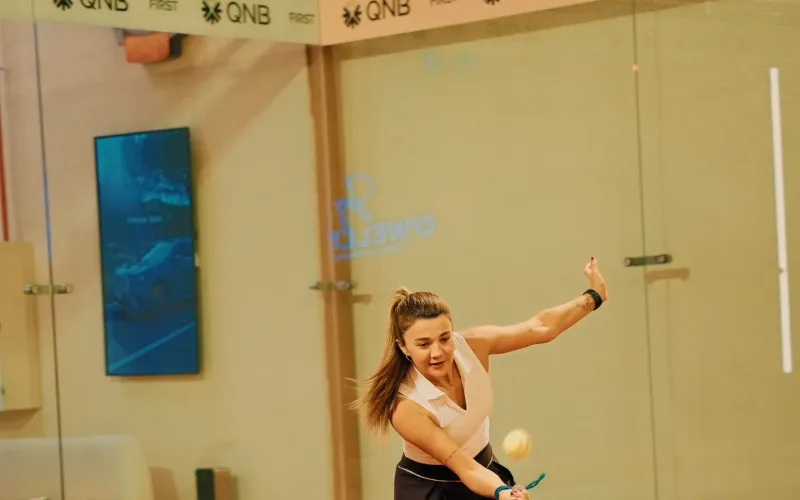
On shots such as the smash, bandeja and víbora, you may have to look at the lighting directly.
- Adjust your position: As you get under the ball, you can take a step or two to the side to move the light source out of your field of view.
- Squinting: Reduces glare but also narrows your field of view; it should be used briefly.
- Cap: The visor cuts light coming from above. It can be useful on an indoor court.
- Early decision: Getting into position before the ball reaches its peak shortens the time you spend looking at the light.
5. Visual tracking on wall rebounds
Tracking a ball coming off the wall is a visual skill specific to padel.
- Follow the ball all the way to the wall; don't try to predict its rebound.
- As you approach the wall, turn your head to the side and keep the ball in your field of view.
- In double-wall situations (back + side), watching the ball's first contact makes it easier to anticipate the second rebound.
Glare and Reflection Management
- Choosing a court: If the facility has several courts, you can prefer the one with more even lighting.
- Side preference: Assess both sides during the warm-up and notice which has more suitable lighting conditions.
- Using a cap: The most practical solution for glare from above.
- Glass reflections: Notice them during the warm-up; outside light sources can create reflections, especially in the evening hours.
- Notifying the facility: If there is a faulty or flickering lamp, tell the staff.
Ball Color and Contrast
- Standard padel balls are in yellow-green tones; this creates good contrast with most floor colors.
- Very old, faded balls make visual tracking harder.
- Dirty, sand-covered balls cause a loss of both visual and physical performance.
- On blue or green floors, contrast is generally good.
- Playing with new balls also gives an advantage in visual clarity in serious matches.
Visual Focus Drills
Visual skills also improve with training.
1. Reading the ball number
Trying to read the number or brand on padel balls in flight. It teaches you to focus closer to the ball and for longer.
2. Early prediction drill
Ask your partner to hit balls in random directions; try to predict the ball's direction at racket contact and say it out loud. It improves your reading skill.
3. Visual switching (near-far focus)
Alternately focusing on a near object (3-4 seconds) and a far object (3-4 seconds). It works the speed at which the eye muscles change focus. 2-3 minutes a day.
4. Peripheral vision drill
While looking at a central point, trying to notice movement in the side areas. Necessary in padel for seeing your partner's and opponents' positions.
5. Head stabilization drill
During training, focus solely on keeping the head still; check with a video recording.
6. Reaction ball
Working with an irregularly bouncing ball improves both visual tracking and reaction speed.
Eye Health and Padel
- If you wear glasses: You need to secure them with a sports strap. Shatterproof lenses or sports glasses are safer.
- If you wear contact lenses: Generally more practical than glasses for padel; however, you may want to have eye drops with you for a dry feeling.
- Eye protection: Eye injuries from the ball and racket are rare in padel but possible. Care is needed in close-range net play.
- Regular eye exams: Small changes in visual acuity can affect playing performance.
- Eye fatigue: It can occur in long matches and under intense lighting; looking into the distance between games helps.
If you notice any change in your vision (blurring, double vision, increased sensitivity to light), you should see an eye doctor.
Indoor vs. Outdoor Court Comparison
- Indoor courts: Fixed and predictable lighting; no wind; however, glare and reflection management may be needed.
- Outdoor court in daytime: Natural light; however, the sun angle changes and one side can be at a disadvantage.
- Outdoor court in the evening: Artificial lighting; contrast is high because the surroundings are dark, but light sources shine more prominently.
- Adaptation: If you switch between the two environments, allowing time for visual adjustment in the first games is useful.
Visual Preparation in the Warm-Up
The warm-up should also have a visual component:
- Play the first balls at a slow tempo and assess the lighting conditions.
- Hit a few lobs and test the light on overhead shots.
- Play from both sides to notice the difference in conditions.
- Try wall rebounds a few times to calibrate your visual tracking.
- If you will use a cap, put it on in the warm-up and get used to it.
Conclusion
Vision on an indoor padel court is a factor that needs to be managed as much as technical skills. The three most important practices: catching the ball the moment it leaves the opponent's racket (early focus), keeping the head still during the shot, and avoiding looking straight into the light on overhead shots by shifting position a step or two. Wearing a cap is the most practical solution for glare management; playing with new, clean balls noticeably improves visual clarity. Setting aside part of the warm-up to assess lighting conditions prevents adaptation problems in the first games of the match.


 Padel Courts
