
The half volley in padel is a shot played right after the ball touches the ground, before it has had a chance to rise. Most players do not choose this shot deliberately; they usually use it out of necessity when they meet a low ball the opponent has aimed at their feet as they move to the net. A player who can play the half volley well, however, gets out of these difficult moments without losing position. In this article we explain when the half volley is needed, how it is hit and which drills build confidence with it.
When does the half volley come up?
The most typical situation arises when you are moving forward to the net after a serve or after a lob. While you are in the transition zone in the middle of the court, the opponent sends a low, slow ball to your feet. The ball is too low to be met with a volley and too close for you to step back and play it off the ground. At that point the half volley becomes the only sensible option.
Shots such as the chiquita, which aim to hit the opponent at their feet, directly force a half volley. If the opposing pair does not want you to settle at the net, they will try to catch you in the transition zone. That is why the half volley is a defensive shot attacking players cannot ignore. Every player who likes to come to the net should have it in their bag.
Sometimes the half volley is the result of your own mistake. When your timing coming to the net is late or you make your split step in the wrong place, a ball that would normally be a comfortable volley drops at your feet. In that case the half volley is a rescue shot, and the real solution is to fix your footwork next time.
The half volley also has a form seen near the glass. When a ball coming off the back glass bounces lower and faster than you expected, you may need to meet it as it leaves the ground, before it sticks to the glass. The principle is the same here: a short movement, a low stance and getting the ball safely across. A half volley played with the glass makes timing even more critical.
In short, the half volley is not the flashiest shot in the game, but it can be one of the shots that saves the most points. Accepting it and playing it without fear also increases your courage to come to the net. Every ball the opponent aims at your feet then becomes not a threat but a stage to pass with a calm touch.
Technique: short, low and calm
The basic rule of the half volley is a short swing. Because the ball has only just left the ground, there is very little reaction time and a big backswing ruins the timing. Keep the racket in front, just ahead of your body, and meet the ball almost with a blocking motion. Take the power from the ball's own pace; your job is to give it direction and height.
Bending the knees is perhaps the most important detail in the half volley. Reaching down to the ball by bending at the waist both upsets your balance and makes the racket angle harder to control. Instead, lower yourself from the knees, keep your torso as upright as possible and try not to let the racket head drop far below wrist level. Having your eyes close to the ball lets you see the contact point more clearly.
The angle of the racket face decides where the ball goes. A slightly open face lifts the ball safely over the net and gives it a deep arc. A face that is too open pops the ball up and gives the opponent an easy smash. A closed face buries the ball in the net. To find the right angle, your first aim should be to send the ball back low and slow toward the opponents' feet.
Common mistakes
- Trying to hit the ball with a big swing
- Bending at the waist without bending the knees
- Trying to turn the ball into a winner straight away
- Staying put after the shot instead of completing your position
What these mistakes have in common is approaching the half volley like an attacking shot. In fact the job of the half volley is usually not to end the point but to neutralize the rally and buy you time to settle at the net. Adopting this outlook reduces tension in the shot and lowers your error rate.
Another detail concerns the wrist. In the half volley the wrist should stay firm and stable. Trying to direct the ball by breaking the wrist changes the angle of the racket face at contact and makes the result unpredictable. Taking direction from a slight turn of the shoulder and torso rather than the wrist gives a more consistent shot. This principle is shared with the volley, but it matters even more in the half volley because there is less time.
Target selection should also be kept simple. In most cases the safest target is the middle of the opposing pair or their feet. A low ball through the middle can make both opponents hesitate and makes it harder for them to create angles. Targets near the lines or down the line demand a precision that does not suit the nature of the half volley.
After the shot: completing your position
The first thing to do after a half volley is to complete your move toward the net. If you sent the ball low and deep, the opponents' next shot will most likely be defensive as well. This short moment is the best chance to move into the net position. Standing still and watching the ball invites the next ball to land at your feet too.
Coordination with your partner also matters here. While you deal with the half volley, your partner should move forward in line with you or keep the balance by waiting for you. If one of you is at the net and the other stays back, a big gap opens in the middle of the court. A simple verbal cue, such as saying 'going in', makes it easier for both of you to move at the same time.
In some situations the right decision is to step back after the half volley. If the opposing pair is strong at the net and your ball did not stay low enough, going forward can make you an easy target. Being able to make this decision instantly develops with experience; a short assessment after each half volley strengthens that instinct.
Building confidence through drills
The most effective way to improve the half volley is to play it again and again in a predictable setting. At first your partner or coach can toss the ball by hand just in front of your feet. You only try to send the ball to the other side, beyond the service line, with a short touch. At this stage the aim is not speed but clean contact.
In the second stage the drill becomes dynamic. While you walk from the baseline toward the net, your partner sends low balls and you play a half volley in the transition zone and keep moving forward. Then in the third stage the balls come mixed: some at volley height, some at your feet. This mix develops the ability to decide instantly which shot to play.
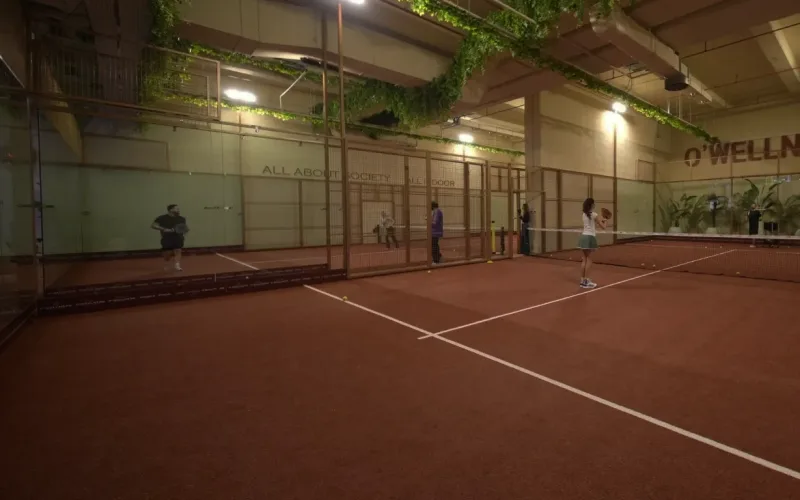
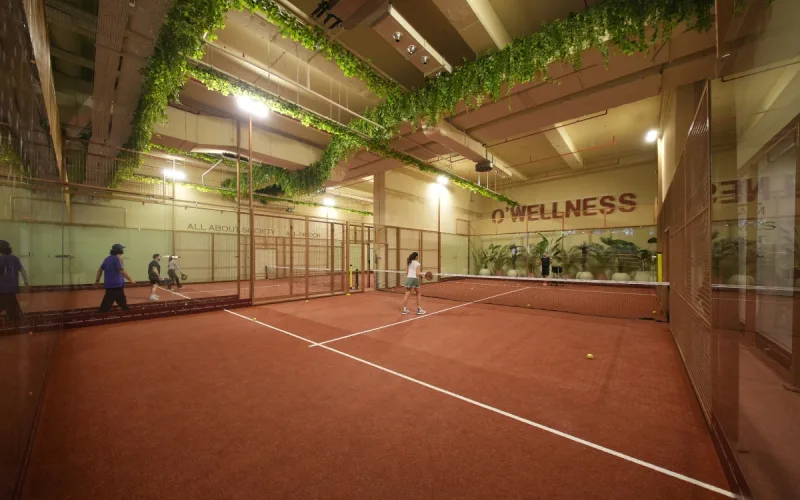
Setting aside a short block on court is enough to do this work regularly. On indoor courts such as O'Padel Sky, floor and bounce conditions are consistent, so it becomes easier to track the same drill comparatively over weeks. Even counting how many half volleys you clear cleanly over the net in each session can be motivating as a way to see your progress.
FAQ
What is the difference between a half volley and a volley?
A volley is met in the air before the ball touches the ground. A half volley is hit right after the ball touches the ground, before it rises.
Should I hit the half volley the same way on forehand and backhand?
The basic principles are the same: a short swing, bent knees and a controlled racket angle. On the backhand side, keeping the racket in front of the body takes more attention for most players.
Can you win points with a half volley?
It is possible, especially if the opponents are out of position. But in most cases the aim of the half volley is to neutralize the rally and gain time to move into the net position.


 Padel Courts
