
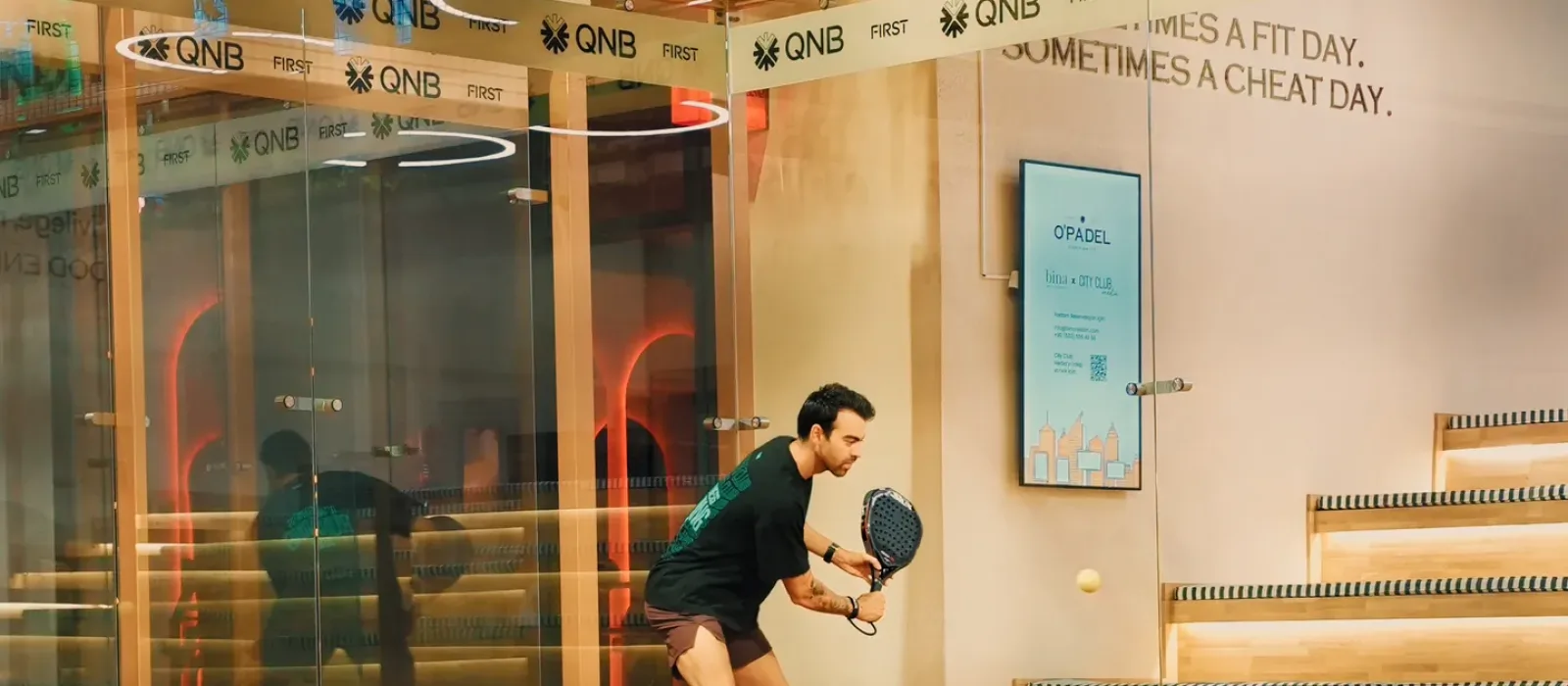
Padel is a social sport because, by its very structure, it is almost always played by four people on a small, enclosed court as a doubles game that requires constant communication. What makes padel a social sport is not just the number of players; it is the short learning curve, the ability of different levels to play together, the post-match club culture and tournament formats in which partners constantly change. These features turn the court into a meeting point.
In this article, the O’Padel Sky coaching team looks at the community impact of padel: which features of the game encourage socializing, how club culture forms, how newcomers settle in and how you can make the most of this social structure. Our examples come from the O’People Sky community at Skyland Istanbul.
How Does the Structure of the Game Encourage Socializing?
Padel’s social character starts with its rules and court design. The 20×10 meter court keeps the four players close to each other; players can see and hear each other at every moment of a rally. On a large tennis court there are meters between you and your partner, while in padel you are usually just a few steps apart.
- Doubles play: Padel is played almost exclusively as doubles; every point is a team effort.
- Constant communication: Short calls such as “mine,” “yours” and “leave it” are part of the game.
- Long rallies: Because the walls extend play, even beginners can enjoy fun rallies.
- Underhand serve: The serve is less a weapon than a way to start the point, which keeps matches balanced.
- Short breaks between points: Brief chats with your partner between points are a natural habit.
For how communication with your partner affects the quality of play, see our article padel partner communication , and for who should take balls down the middle, see who takes the middle ball in padel article.
A Short Learning Curve, an Inclusive Environment
For a sport to be social, people need to be able to join in easily. Padel has an advantage here: the basic rules and shots are learned quickly, and fun matches are possible from the very first lessons. This makes it easy for people of different ages, sporting backgrounds and fitness levels to come together on the same court.
In addition, power is not the only deciding factor in padel. Ball placement, patience, lobs and team chemistry matter at least as much as physical strength. That is why it is not surprising to see, for example, a university student and a retired player happily playing on the same team on a padel court. This also allows players with different physical attributes to play balanced matches. Parents with their children, coworkers with each other, and experienced players with beginners can all enjoy a good match.
| Feature | Social impact |
|---|---|
| Easy start | New players can join groups quickly |
| Power is not the only deciding factor | Different physical profiles can play on equal terms |
| Doubles format | Every match is a four-person social get-together |
| Level system | Balanced matchups, matches everyone enjoys |
| Small, enclosed court | Closeness and communication between players |
If you are new to padel, our article how to start padel on your own explains how you can get started even without a circle of partners.
Summary
- Because padel is played in pairs on a small court, communication and teamwork are at the heart of the game.
- The short learning curve and the fact that power is not the only deciding factor bring together people with different profiles.
- Formats such as Americano and Mexicano let you meet lots of players in a short time.
- At O’Padel Sky, the O’People Sky community welcomes newcomers with Newcomers Night, Women’s Padel Meetups and Sunrise Padel.
Comparison with tennis and other sports
Tennis can also be played as doubles, but the singles format is very common and the size of the court limits communication between players. In individual sports, training is mostly done alone. The rarity of singles in padel makes the sport a group activity from start to finish. For the differences between the two racket sports, see the differences between padel and tennis article.
Tournament Formats: The Fastest Way to Meet People
One of the things that best reflects padel’s social side is the social tournament formats that clubs organize. These formats focus more on meeting people and having fun than on competition.
Americano
In the Americano, players are paired with a different partner each round and play short matches. By the end of the tournament, every player has played with and against many different people. At O’Padel Sky, the Americano is held on Wednesdays and Saturdays. For details on the format, see What is Americano post.
Mexicano
In the Mexicano, pairings are reset based on the results of each round, so over time players are matched with people close to their own level. It offers a setting that is both social and balanced in competition. Details What is Mexicano .
Leagues and club tournaments
8-week level-based leagues and monthly club tournaments let you build long-term relationships with regular opponents and partners. Facing the same group over several weeks creates strong bonds within the club. For the current schedule, see tournaments and leagues page.
The easiest way to join the community is to start on court. Plan your first match on our courts at Skyland Istanbul now.
Club Culture: The Game That Continues Off the Court
Padel’s social impact does not end when the match is over. Conversations in the club areas after a match, planning the next match, watching professional matches together and preparing for tournaments together make up club culture. This culture is one of the strongest things that keeps players connected to the club.
In this environment, players are not just opponents or partners; over time they become a circle that follows and supports each other’s progress. When a player moves up to a higher group in the league or wins their first tournament, the whole club celebrates. An experienced member giving tips to a player learning a new shot is the most natural example of club culture.
Respect and fair play are at the foundation of a strong club culture. Appreciating your opponent’s good shot, giving a ball you are unsure about to your opponent and shaking hands even when you lose are established habits in padel. You can find our tips on this in refereeing and fair play in padel article.
- Shake hands with your opponents before and after the match.
- Give your opponent the benefit of the doubt on uncertain calls.
- Include new players in matches and conversations.
- Leave the court on time and clean for the next group.
- In social formats, focus on enjoyment and balanced play rather than the result.
Lounge and social areas
An important part of club culture is the social areas where players gather before and after matches. These are the places where conversations that started on court continue and new match groups form. You can find our tips on using the lounge after a match in padel lounge article.
O’People Sky: The Community Experience at Skyland
At O’Padel Sky, the community is called O’People Sky. It is shaped by regular events that aim to help everyone, from newcomers to experienced players, find their place in the club.
- Newcomers Night: On the first Thursday of the month, a meet-and-play night for players new to the club. Details What Is Newcomers Night .
- Women’s Padel Meetups: Regular matches for women players in a supportive environment. Details Women’s Padel Meetups in Sarıyer .
- Sunrise Padel: Players who start the day together at 6:30 a.m. Details Sunrise Padel Sky .
If you are curious about our club players’ experiences, O’Padel Sky community stories take a look at our article. For all events, see community follow our page.
How the Social Side Relates to Health and Motivation
One of the biggest obstacles to sticking with a sport is losing motivation. Padel’s social structure offers an important advantage here: in a four-person match, saying “I’m not coming” is much harder than skipping the gym on your own. This mutual commitment within the group naturally supports regular attendance.
It is also widely accepted that social connections and enjoyable activities can contribute to overall well-being. For many players, time on court is not just exercise but the social get-together they look forward to all week. That said, if you are experiencing loneliness, anxiety or symptoms of depression, it is important to reach out to a health professional; sport does not replace that support. For the other benefits of padel, see padel benefits article.
Family and friend groups
Padel is also a practical option for family members and groups of friends to spend time together. Family members of different ages can play on the same court, and level differences can be balanced through pairings. A family match on a weekend morning or a regular evening match with a group of friends can become a fixed part of your weekly social rhythm. Tips for kids padel for kids .
Social padel for corporate teams
Padel’s social structure is also valuable for corporate teams. A mini tournament in which employees from different departments play in mixed teams creates a natural setting for communication outside the office. For team events, see corporate events page.
Practical Steps to Join the Community
Joining a new club can feel intimidating at first, especially if you don’t know anyone. Although padel’s social structure makes this easier, taking a few deliberate steps will help you settle in faster.
- Find out your level: A short assessment with a coach makes sure you are directed to groups that suit you. Details padel level assessment .
- Join a meet-and-greet event: Newcomers Night and the Americano are the most relaxed settings for first introductions.
- Share your contact details: After an enjoyable match, don’t hesitate to plan the next one with your partners.
- Pick a set day: Being at the club on the same day and time every week means you will see the same faces and become part of the group.
- Be open to helping out: Joining a group that is looking for a missing player is the fastest way to make new connections.
During your first weeks at the club, remember that everyone was new once. Most experienced players are happy to include newcomers in their groups. A simple question can be the start of a long-lasting padel friendship.
Match etiquette: An environment everyone enjoys
Whether everyone enjoys a social match depends on the care players show each other. In matches with a level gap, an experienced player slowing the pace a little keeps the beginner in the game. Keeping score disputes short and a quick thank-you at the end of the match keep the door open for the next match invitation. Knowing the rules well also reduces disputes; complete guide to padel rules helps with this.
Conclusion
What makes padel a social sport is that it is played in pairs, its short learning curve, a structure that brings together different profiles, tournament formats where partners change and a club culture that continues off the court. At O’Padel Sky, located in Skyland Istanbul in the Huzur neighborhood of Sarıyer, the O’People Sky community brings together players from the Maslak, Levent, Ayazağa and Zekeriyaköy area with Newcomers Night, Women’s Padel Meetups, Sunrise Padel, the Americano and leagues. You can get to know our courts on our padel courts page, take the first step with padel lessons and book your match when making your court reservation page.
FAQ
You can start by taking a beginner lesson or by joining Newcomers Night, held on the first Thursday of the month. These events make it easier to find partners.
Social formats are generally open to different levels; the level system helps create balanced matchups. You can ask the team which event is right for you.
Membership is not required at O'Padel Sky. For event participation details, you can get information on the +90 539 675 54 54 WhatsApp line.



 Padel Courts
