

Mexicano padel is a social tournament format in which players are paired dynamically based on standings updated at the end of every round, so those close to each other in the rankings meet on the same court in the next round. In the shortest terms: Americano’s competitive sibling. The first round starts randomly or by level, and every round after that is built on the principle of “winners with winners, losers with losers”; this way, matches become more balanced as the tournament progresses and the final rounds turn into a real finals atmosphere.
At O’Padel Sky, Mexicano nights are scheduled for players who are used to Americano and want slightly tougher competition. In this guide, the O’Padel Sky coaching team explains the format’s pairing logic, scoring system, how it differs from Americano and tactics that will lift your ranking in Mexicano.
Summary
- In Mexicano, pairings aren’t set in advance; they’re rebuilt after every round based on the current standings.
- Standard pairing: the players in 1st and 3rd place play against those in 2nd and 4th; the next foursome is paired using the same logic.
- Matches are played to a fixed number of points (usually 16, 21 or 24 at Sky), with no sets; points are added to your individual total.
- As the rounds progress, level differences shrink; your ranking reflects your true level more precisely than in Americano.
- At Sky, Mexicano is a competitive round for players rated 3.0 and above, and a chance for beginners to gauge their level.
How Does Mexicano Work? Step by Step
The heart of Mexicano is the standings table recalculated at the end of every round. The process goes like this:
- First-round pairing: Players are split into foursomes randomly or by known level. At Sky, play usually starts by level for players with a known rating (1.0–7.0), and randomly for those without one.
- Match: A fixed-point match is played, for example to 24 points. If the score ends 15-9, both players on the winning pair get 15 points and the players on the losing pair get 9.
- Standings update: When all courts are finished, everyone’s total points are calculated and the table is re-sorted.
- New pairing: The top four players in the standings go to Court 1, the next four go to Court 2, and so on. The pairing rule in each foursome: 1 + 3 vs 2 + 4.
- Repeat: This cycle continues for the set number of rounds (usually 6–8). At the end of the last round, the player with the highest point total wins the Mexicano.
The result of this structure: say luck was on your side in the first round and you won 20-4 with a strong partner against weak opponents; in the second round you’re now on Court 1 facing the best players of the day. Luck corrects itself over the course of the tournament.
The Pairing Rule: Why 1+3 vs 2+4?
The simplest pairing in a foursome would be “1+2 vs 3+4,” but that puts the two best players on the same team and makes the match lopsided. “1+4 vs 2+3” tries to balance total strength, but since it pairs the best player with the weakest, it can frustrate both. The “1+3 vs 2+4” formula brings both teams’ combined strength closer together and puts the best and second-best against each other. That’s why it’s Mexicano’s standard pairing.
| Pairing model | Team 1 | Team 2 | Conclusion |
|---|---|---|---|
| 1+2 vs 3+4 | The top two | The bottom two | Unbalanced, one-sided |
| 1+4 vs 2+3 | Best + weakest | The middle pair | Balanced but an extreme pairing |
| 1+3 vs 2+4 | 1st and 3rd | 2nd and 4th | Balanced, top two face each other (standard) |
Some clubs and apps apply extra rules that prevent the same two players from partnering back to back. The app used at Sky automatically limits these repeats; however, in small groups (8 people), repeat pairings in the final rounds may be unavoidable.
Scoring and Tiebreakers
Mexicano’s scoring is the same as Americano’s: every rally is a point, the match is played to a fixed total, and the serve changes hands every 4 points. But since the rankings are more critical, tiebreak rules matter more. The ranking criteria used at Sky:
- Total points (primary criterion)
- Number of matches won
- Difference between points won and lost (point difference)
- Head-to-head result (if any)
Because points need to be updated after every round, Mexicano is almost always run with a mobile app; tracking it on paper is tiring even with 8 people. At Sky, the app screen is visible in the common area, and following the standings between rounds is one of the most exciting moments of the evening. For a detailed explanation of the rules, read our post Mexicano tournament rules .
Mexicano vs Americano: Which One Is Right for You?
The two formats share the same scoring logic; the difference is in the pairing. Americanohas a fixed rotation, everyone partners with everyone, and a mix of levels is maintained all day. In Mexicano, pairing depends on performance, and as the rounds progress you play with people at your own level.
| Criterion | Americano | Mexicano |
|---|---|---|
| Pairing | Fixed rotation set in advance | Dynamic, based on points each round |
| Level balance | Mixed, varied all day | Balances out as the rounds progress |
| Competition intensity | Medium, social focus | High, final rounds feel like finals |
| Luck factor | Depends on the rotation, higher | Corrects itself, lower |
| For beginners | Very suitable | Suitable, but the first rounds can be tough |
| Level measurement | Approximate | More precise |
| Running it on paper | Possible | Requires an app |
The short answer: if you want to socialize and play relaxed, Americano; if you want to test your level and feel the tension of the final round, Mexicano. Most Sky players use the Wednesday Americano as their routine and Mexicano as a monthly “exam.”
Before Mexicano night, book one of the courts at Skyland with your partner to work on serves and returns.
7 Tactics to Climb the Mexicano Standings
Dynamic pairing changes tactical thinking too. In Americano, you can play with the same approach all day; in Mexicano, every round presents a different context.
- Bank points in the first round. The first round is usually the most lopsided match. If your opponents are weak, be ruthless; the 7 points between 20-4 and 13-11 can be the difference between the top three and the top seven at the end of the day.
- Simplify your game plan when you move up to Court 1. You’re playing with the best of the day; low errors and good lobs win, not fancy shots.
- Collect points even when you’re losing. Don’t give up when you realize you’ll lose the match; the difference between 9 points and 5 points can mean dropping down a court in the standings.
- Get on the same page with your new partner quickly. In Mexicano, partners repeat less often; settle sides and who takes the middle ball in the first 30 seconds. Partner communication turns directly into points here.
- Know where your opponents are in the standings. If you’re facing the player right above you in the rankings, this match means a direct swap of places; spend your energy here.
- Save your energy between rounds. Mexicano’s final rounds are the toughest matches; keep a steady pace instead of sprinting in the early rounds, and don’t skip water.
- Keep your serve safe. With service turns of just 4 points, a double fault is unforgivable. First-serve percentage is Mexicano’s hidden ranking criterion.
Mexicano Night at Sky: Practical Information
At O’Padel Sky, Mexicano is usually organized with 8 or 12 players, on 2–3 courts, over 6–7 rounds. The total time is 2–2.5 hours. What you need to know:
- Level range: Each Mexicano is opened for a specific level band (for example, 3.0–4.0). Even though dynamic pairing balances things out, being outside the band wears out both you and the group. If you’re not sure of your level, start with the Sky level assessment process .
- Registration: Individual; no partner required. No membership required.
- Equipment: Rackets can be rented; balls are provided by the club.
- Time discipline: A new round doesn’t start until all courts are finished, so long arguments that drag out your match keep the whole group waiting. In a scoring dispute, replaying the point is the most practical solution.
- Afterward: The standings are shared, the top three are announced, and the evening continues at the O’Break Lounge. The sauna and cold plunge at Skyland save your muscles the morning after an intense Mexicano night; check out the recovery options .
A Sample Mexicano Night: 8 Players, 3 Rounds
To make the format concrete, let’s follow the first three rounds of an 8-player, 24-point Mexicano. In the first round, players are randomly split across two courts. On Court 1, Ayşe and Mert beat Deniz and Can 17-7; on Court 2, Ece and Burak beat Selin and Kaan 13-11. Standings: Ayşe 17, Mert 17, Ece 13, Burak 13, Selin 11, Kaan 11, Deniz 7, Can 7.
The second-round pairing is built from the standings. The top four (Ayşe, Mert, Ece, Burak) go to Court 1 and, under the 1+3 vs 2+4 rule, Ayşe and Ece play against Mert and Burak. The bottom four are on Court 2: Selin and Deniz against Kaan and Can. Ayşe and Mert, partners in the first round, are now opponents. If the match on Court 1 ends 12-12, all four get 12 points and the top of the table gets tight; if Kaan and Can win 15-9 on Court 2, Kaan moves ahead of Ece and Burak (25) with 26 points and moves up to Court 1 in the third round.
This three-round example shows Mexicano’s character: there’s constant movement between Court 1 and Court 2, every point has a visible effect on the table, and the rankings aren’t settled until the last round. Over an evening of 6–7 rounds, this dynamic turns the final-round matches into real finals.
Who Is Mexicano Right For?
Mexicano benefits three profiles the most. First, the player who wants to see their level objectively: instead of luck-based results from a fixed rotation, they play opponents close to their own level throughout the rounds, so the table becomes a more honest mirror. Second, the player preparing for a club tournament or league: the tense, balanced matches of the final rounds are the best rehearsal for tournament pressure; we cover this in detail in our tournament prep guide . Third, mixed groups with large level gaps: on an evening with players ranging from 2.5 to 4.5, Americano challenges everyone, while Mexicano places everyone in their own league after two rounds.
Mexicano isn’t off-limits for beginners either; however, being paired with strong players in the first rounds and losing by a big score can be discouraging. In that case, we suggest finding your rhythm with Americano for the first few weeks and then moving on to Mexicano. If you want to look at all the formats, our padel tournament formats guide also compares knockout, group and round robin systems.
Conclusion
Mexicano is a smart format that keeps padel’s social spirit while turning up the competition. The table updated after every round evens out luck and makes sure you end the evening where you deserve to be. Held on the O’Padel Sky courts inside Skyland Istanbul in Sarıyer, Mexicano nights have become a routine where players coming after work from Maslak and Levent test their level, feel real finals tension in the last round, and then debate the standings in the lounge with Bosphorus views. From the tournament and league calendar, check the date of the next Mexicano and focus on banking points in the first round.
FAQ
The first round is set up randomly or according to known level ratings. At Sky, players with a known level are paired by level and those without one are paired randomly. Subsequent rounds depend entirely on the current standings.
It's possible, especially in the final rounds of small groups of 8. The app used tries to limit repeats, but the ranking rule takes priority; if the standings require it, a repeat pairing can happen.
In theory yes, in practice it's hard. At the end of every round, all players' total points need to be calculated and re-sorted. That's why most clubs, including Sky, use a mobile app.
Yes. The rankings are based on total points; the 11 points you get in an 11-13 loss are more than the 9 points earned by the opponent of a player who won 15-9 on another court. Collecting points while losing is a core Mexicano tactic.


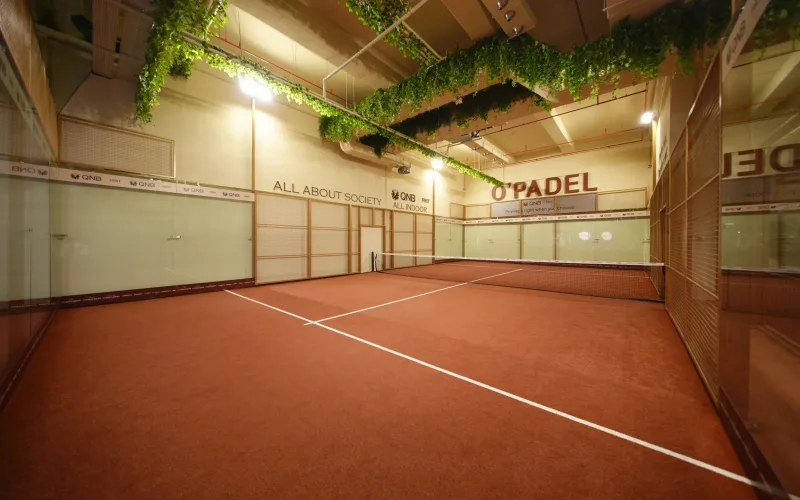


 Padel Courts
