

A padel conditioning program is a structured training plan that develops strength, speed and endurance together so you can sustain explosive speed, sudden changes of direction and repeated overhead shots for 60–90 minutes on court. The short answer: an 8-week cycle of 2 strength + 1 speed/agility + 1 aerobic session per week, alongside 2–3 court sessions per week, is the most effective starting point for most club players.
In this guide, the O’Padel Sky coaching team shares the 8-week framework we use with players ranging from level 2.0 to 5.0. We split the program into two phases, give sample sessions for each week and explain how to sync it with your court time. The goal is not for you to run more; it is to be in the right place at the right time, with legs that still respond when the third set comes around.
Summary
- Padel is an intermittent (interval) sport made up of short sprints, braking, turning and overhead shots; your conditioning program should mimic this structure.
- The 8-week framework: weeks 1–4 build foundational strength and movement quality, weeks 5–8 build power, speed and court-specific endurance.
- Weekly split: 2 strength, 1 speed/agility, 1 aerobic-interval session + 2–3 court sessions.
- Preventive work for the shoulder, elbow and ankle is part of every strength day.
- Recovery (sleep, nutrition, sauna/cold therapy, massage) is not an optional extra but a structural part of the program.
The physical demands of padel: what are we preparing for?
To make the program meaningful, first look at what the game asks of your body. A padel point usually lasts from a few seconds to 20–30 seconds, followed by a short break to set up for the serve. In other words, the game is not continuous running but a cycle of repeated high-intensity efforts and short rests. This shows that endurance does not mean “being able to run for a long time” but “being able to repeat high intensity again and again.”
Three things dominate the movement profile: positioning with short sideways and backward steps, sudden braking and recovery for a ball coming off the glass, and repeated shoulder rotation for the bandeja and smash at the net. On a 20×10-meter court, the distance a player covers in a single point is small, but the number of changes of direction is high. That is why the focus of the program is not straight-line running speed but braking-acceleration capacity and single-leg stability.
Finally, stroke mechanics: in padel, power starts not from the wrist but from the legs and is transferred to the racket through hip and trunk rotation. If your core and hip strength are weak, the missing power is “borrowed” from the shoulder and elbow, which over time sets the stage for overuse injuries. We cover this topic in detail in our articles on tennis elbow and shoulder injuries .
The four pillars of the program
The 8-week plan rests on four components. Each corresponds to a separate session type and has its own place in the weekly schedule.
1. Strength
Squat, lunge and hip hinge patterns for the lower body; push-pull balance and shoulder girdle stabilization for the upper body. Strength is the foundation of both hitting power and injury resistance. Heavy lifting is not required; moderate loads worked with a controlled tempo and full range of motion are enough for a club player.
2. Power and speed
The phase that turns strength into speed. Short sprints, lateral jumps, medicine ball rotational throws and reaction drills. These sessions should be short and high quality; never train speed when you are tired.
3. Endurance
There are two layers: an aerobic base (30–40 minutes of continuous low-intensity effort) and court-specific intervals (15–30 seconds hard / 20–40 seconds rest). Together, they help you maintain the quality of your decisions in the last half hour of a match.
4. Mobility and preventive work
Thoracic spine rotation, hip internal and external rotation, ankle dorsiflexion and posterior shoulder capsule flexibility. Plus low-load prehab exercises for the rotator cuff, forearm extensors and ankle stabilizers. These go into the warm-up of every strength day; we have also expanded them into a standalone routine in our mobility routine article.
Weekly schedule: how to sync it with your court time
The most common mistake with a conditioning program is clashing with your court time. Playing an Americano the morning after a heavy leg day lowers both your performance and what you get out of the program. The template below is designed for a player who plays 2–3 court sessions per week; you can shift it to fit your own days.
| Day | Session | Duration | Note |
|---|---|---|---|
| Monday | Strength A (lower-body focus) | 50–60 min | No court; heaviest load day |
| Tuesday | Court session / lesson | 60–90 min | Legs may be slightly tired; play with a technical focus |
| Wednesday | Speed & agility + Americano | 25 min + match | Speed work before the match, as a warm-up |
| Thursday | Strength B (upper body + core + prehab) | 45–50 min | Shoulder and elbow protection happens here |
| Friday | Aerobic base or active recovery | 30–40 min | Swimming, cycling, brisk walking |
| Saturday | Court session / tournament | 90+ min | The week’s main competition day |
| Sunday | Mobility + recovery | 30 min | Sauna, cold therapy, stretching |
In a tournament week, lighten the Monday strength session and turn Thursday into a mobility day. If you have a fixed weekly slot, build the program around it; if you play Sunrise Padel at 06:30, do not schedule heavy strength work that evening.
Phase 1 — Foundation (weeks 1–4): movement quality and a strength base
The goal of the first four weeks is to build a base that can safely carry the speed and power work you will load in the next four weeks. Controlled tempo, moderate reps, near-perfect technique. Each session starts with an 8–10-minute dynamic warm-up; for warm-up details, see our 10-minute dynamic routine article.
Strength A (lower body + trunk)
- Goblet squat — 3×10, 3-second descent. Keep the knee aligned with the ankle and the heels in contact.
- Romanian deadlift (dumbbell) — 3×10. Hamstrings and the hip posterior chain; the source of your braking capacity.
- Lateral lunge — 3×8 per side. The side-step pattern is padel’s main movement.
- Single-leg calf raise — 3×12 per side. Ankle and Achilles preparation.
- Dead bug — 3×8 per side. Breathing and trunk control.
- Pallof press — 3×10 per side. Anti-rotation; resisting rotation comes before rotational power.
Strength B (upper body + prehab)
- Single-arm dumbbell row — 3×10 per side. Pulling volume should exceed pushing volume.
- Push-up or incline push-up — 3×8–12. Watch your shoulder blade movement.
- Face pull (band) — 3×15. A key movement for the rear shoulder and rotator cuff.
- Shoulder external rotation (band, elbow at 90°) — 3×15 per side. Slow and light.
- Eccentric forearm extensor — 3×12. Light dumbbell, palm down, 3–4-second lowering. Elbow protection.
- Side plank — 3×30 seconds per side.
Speed & agility (Phase 1)
In this phase, the speed session is short and technical: 4×10 meters lateral shuffle, 4×5 meters forward sprint + backpedal, 3×10 seconds of fast feet. Full rest between sets. The goal is correct footwork mechanics rather than explosiveness; for details, see split step and shuffle .
Aerobic base
30–40 minutes at a conversational pace. Swimming in the semi-Olympic pool at O’Wellness Sky, cycling or brisk walking. This session speeds up recovery and helps your heart rate drop faster in the closing stages of matches.
Phase 2 — Power and court-specific endurance (weeks 5–8)
Once the base is set, it's time to convert strength into speed. In strength sessions, reps drop and movement speed rises; reaction and change of direction are added to the speed session; the aerobic session switches to an interval format. Total volume doesn't increase; intensity does. Track signs of fatigue weekly; we covered how often you should play per week in our training load management article.
Strength A (power)
- Box jump or squat jump — 4×5. Soft landing; quality, not conditioning.
- Trap bar deadlift or heavy goblet squat — 4×6.
- Lateral bound (jump sideways and stick on one leg) — 3×5 per side. Braking + staying balanced.
- Bulgarian split squat — 3×8 per side.
- Medicine ball rotational throw (against a wall) — 3×6 per side. In the forehand and backhand directions.
- Copenhagen plank — 3×20 seconds per side. Adductor protection.
Strength B (upper-body power + protection)
- Medicine ball overhead throw (slam) — 3×8. The entire smash chain.
- Chest-supported row — 4×8.
- Landmine press or half-kneeling single-arm press — 3×8 per side. Overhead movement with upward rotation of the shoulder blade.
- Band 90/90 external rotation (in abduction) — 3×12. This is the bandeja position itself.
- Farmer’s carry — 3×30 meters. Grip and trunk.
- Eccentric forearm extensor — continue, 3×15.
Speed & agility (Phase 2)
- Partner reaction: your partner signals right/left, sprint 3 meters sideways + return. 6–8 reps.
- T-drill: 4–5 reps, full rest.
- Split step + first step: 8 reps, from the return-of-serve position.
- Off-the-glass simulation: start at the net, run to the back glass, turn, sprint to the middle of the net. 5 reps.
Court-specific intervals
Mimic the rhythm of a padel point: 20 seconds hard (shuffle + sprint + shadow swing), 25 seconds of walking rest; 8 reps = 1 “game.” 2-minute break, 3 games. About 20 minutes in total. Every two weeks, increase the work time to 25 seconds rather than the number of reps. For more on heart rate zones, see our cardiovascular effects article.
Sample session: Strength A minute by minute
It helps to see how the program flows in the gym, not just how it looks on paper. Below is a sample flow of a Phase 2 Monday Strength A session; total time is about 55 minutes.
- Min 0–8 — Warm-up: 3 minutes of cycling or running in place; then walking lunge + rotation, lateral lunge, leg swings, arm circles, ankle circles. Tempo from light to moderate.
- Min 8–14 — Power prep: 2 sets of 5 squat jumps, light; land quietly. Wakes up the nervous system.
- Min 14–30 — Main strength: Trap bar deadlift 4×6, 2 minutes between sets. The last set should be challenging but finished without technique breaking down.
- Min 30–44 — Single leg and braking: Lateral bound 3×5 per side alternated with Bulgarian split squat 3×8 per side. 60–90 seconds between sets.
- Min 44–52 — Rotation and trunk: Medicine ball rotational throw 3×6 each direction, Copenhagen plank 3×20 seconds.
- Min 52–55 — Cool-down: Hip flexor, hamstring and calf stretches, 25 seconds each; prepares your legs for the next day’s court session.
The total number of heavy reps in the session may look low; for a padel player, the goal is not to pile fatigue on the muscles but to build strength you can use on court. If you struggle on the stairs the next day, the load was too much; lower the weight the following week.
The best way to test the program on court is to play regularly. Book a fixed weekly slot at Sky and build your conditioning schedule around your court time.
Adjustments by level
The same framework is applied in different doses at different levels. If you do not know your level, our coaching team can guide you with a level assessment.
| Level | Strength | Speed | Endurance | Priority |
|---|---|---|---|---|
| 1.0–2.5 (beginner) | 1–2 times a week, bodyweight + light dumbbells | Technical shuffle, 10 min | Aerobic base 2×30 min | Movement quality, injury prevention |
| 3.0–4.0 (club) | 2 times a week, moderate load | Reaction + change of direction, 20 min | 1 base + 1 interval | Braking capacity, shoulder endurance |
| 4.5+ (competitive) | 2–3 times a week, power-focused | Partner reaction, 25 min | 1 interval + match load | Repeatability on tournament day |
If you are over 40, keep the rep counts, reduce the load by 10–15% and add more rest days. For a joint-friendly approach, we recommend our article on age-specific training adjustments .
Equipment and setting: where will you do the program?
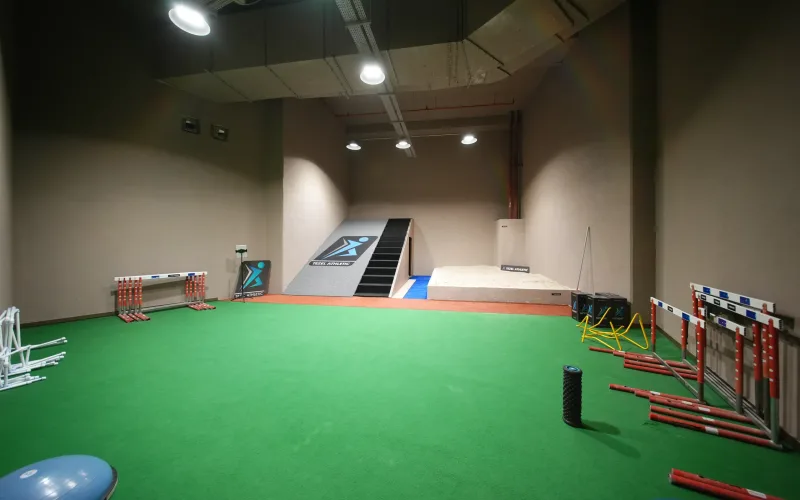
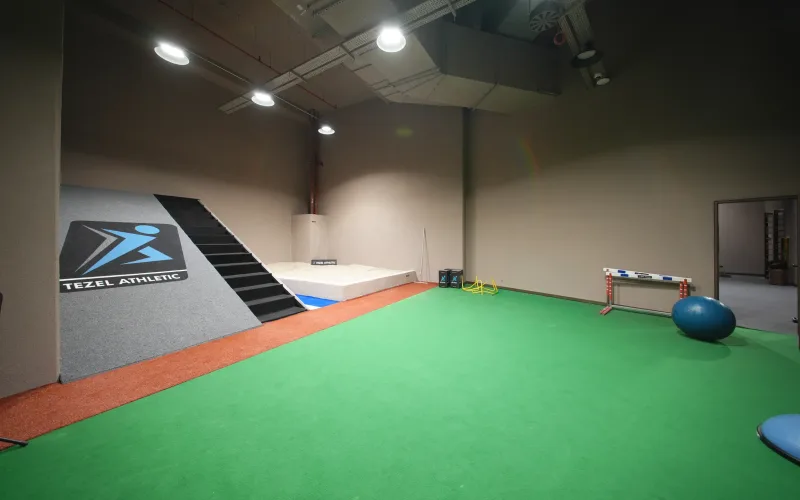
The equipment you need for the whole program is a short list: a pair of adjustable dumbbells or a kettlebell, two bands in medium and light resistance, a 3–5 kg medicine ball and a sturdy box or step. The O’Wellness Sky fitness area at Skyland has all of these, and because it is on the same floor as the courts, you can easily fit a strength session before a court session or on the following day. If you are training at home, you can use a heavy goblet squat instead of the trap bar deadlift and squat jumps in place instead of box jumps; the logic of the program stays the same. A non-slip floor is important for ankle safety, especially in lateral bounds and change-of-direction drills.
Injury prevention: the hidden half of the program
The most common problem areas in padel are the outside of the elbow, the front and top of the shoulder, the knee and the ankle. The good news: most of these areas can be strengthened with the low-load protective exercises we added to the strength sessions above. The bad news: these exercises are boring and are the first thing people drop.
- Elbow: Eccentric forearm extensor work and grip training twice a week. Racket stiffness and grip thickness also play a role; our tennis elbow guide has the details.
- Shoulder: More pulling volume than pushing; external rotation and shoulder blade control every week. Increase your number of smashes gradually in training.
- Knee and ankle: Single-leg balance, sticking the lateral bound and calf raises. Shoe choice on sand-filled turf is also a risk factor; see knee and ankle health article.
- Lower back: Anti-rotation (Pallof) first, rotational power (med ball) after. The order matters.
If pain lasts more than two days, morning stiffness increases, or you feel sharp pain on a particular shot, stop training and see a doctor or sports physiotherapist. The sports physiotherapists at O’Athletic Sky in the same complex can use movement analysis to show which pattern is overloading you; we explained why this matters in our sports physiotherapy article. Nothing in this article replaces personal medical advice; if you have an existing condition, consult your doctor before starting the program.
Recovery: adaptation happens during rest, not training
Gains in strength, speed and endurance happen not during training but in the following 24–72 hours as your body repairs itself. That is why the fourth pillar of the 8-week program is recovery, and if you neglect it, the other three go to waste.
Sleep
The most effective and cheapest recovery tool. Poor sleep lowers reaction time and decision quality, and in padel those translate directly into points. Consistent sleep and wake times, a dark and cool room and limiting caffeine after matches are the basic steps. We go deeper into the topic in our sleep and performance article.
Nutrition and hydration
Even on an indoor, climate-controlled court, you lose a significant amount of fluid in a 90-minute match; make a habit of drinking before you get thirsty. A meal with protein and carbohydrates within 1–2 hours after a match supports muscle repair. For detailed plans, check out our articles on nutrition guide and hydration .
Hot-cold therapy and massage
After a match or a heavy strength day, sauna, steam room and cold plunge are methods many players choose to ease muscle tension and perceived fatigue. In weeks when you are targeting strength gains, it makes more sense to use cold therapy a few hours later or on match days rather than right after a strength session. At Skyland, you can add sauna, steam, cold plunge and sports massage after your match at O’Spa Sky, just a few steps from the court; you will find the options on our recovery & wellness page. We cover the timing of sports massage in this article, and the science of sauna and cold therapy in our recovery guide . If you have a cardiovascular condition, blood pressure problems or are pregnant, be sure to consult your doctor before using the sauna or cold therapy.
Deload week and warning signs
A “deload” week every four weeks, in which you cut volume and intensity in half, clears accumulated fatigue and lets your gains settle in. You can keep playing on court during this week; what drops is the dose of your strength and speed sessions. Signs that you need a deload: a higher-than-usual morning heart rate, poorer sleep quality, the same load feeling heavier, a slower first step on court and loss of motivation. If two of these signs persist together for a few days, lighten the program without waiting. If the signs continue despite rest, there may be another underlying cause; consult your doctor.
Measuring progress and avoiding mistakes
Five simple tests
You cannot improve what you do not measure. Do the following simple tests at the start of the program and at the end of week 8; no lab needed, just a court and a stopwatch.
- 5-10-5 agility test: 5 m to one side, 10 m to the other side, 5 m back. The most practical measure of change-of-direction speed.
- Single-leg balance (eyes closed): How many seconds you can hold it; a difference between legs signals injury risk.
- 3-minute box step-up + heart rate recovery: Your heart rate after 1 minute; an indicator of your aerobic base.
- Medicine ball rotational throw distance: Both directions; rotational power and symmetry.
- Perceived fatigue: Rate yourself from 1 to 10 in the third set of your Saturday match. This is the most meaningful indicator.
The first change you will feel on court usually comes in the third week: reaching the ball coming off the glass earlier and a quicker first step on the return of serve. Power gains (a harder smash, a deeper bandeja) are usually noticeable after week 6.
Common program mistakes
- Using court time as a substitute for conditioning: Playing matches builds endurance up to a point, but it does not replace strength and preventive work.
- Only running: Long-distance running does not match the nature of padel; you need to train intervals and changes of direction.
- Skipping the warm-up: An 8–10-minute dynamic warm-up is a must before both court and strength sessions.
- Skipping the cool-down and stretching: It increases stiffness the next day; our cool-down routine takes 8 minutes.
- Increasing the load suddenly: Not increasing total weekly volume by more than roughly 10% is a safe guideline.
- Trying new exercises in a tournament week: New movement = new pain. In a tournament week, train lightly with movements you know.
Conclusion: 8 weeks, then what?
At the end of the 8 weeks, instead of starting the program from scratch, continue Phase 2 for another 2–3 weeks, then take a light 1-week “deload” and repeat the cycle with new loads. Conditioning is not a project; it is part of the game. Having the courts, fitness area, physiotherapy team and spa under one roof at Skyland Istanbul makes it easier to keep this cycle going: you can come over from Maslak after work, finish your strength session and head to the court, or wrap up the week with sauna and cold therapy after the Saturday tournament. If you want to make conditioning a natural part of your game in Sarıyer, check out our courts and our tournament calendar ; our coaching team will be happy to tailor the program to your level with you.
FAQ
For a player who plays 2–3 court sessions per week, 2 strength, 1 speed/agility and 1 aerobic session is ideal. If you are short on time, keep the two strength sessions; fold the speed work into your pre-match warm-up and the aerobic session into an active recovery day.
Most of Phase 1 can be done at home with bodyweight, resistance bands and a pair of dumbbells. A small space is also enough for the jumps, medicine ball and single-leg work in Phase 2. A gym is an advantage only for the heavy lifting movements.
No; on the contrary, when hip and trunk strength improve, the kinetic chain works more efficiently and the arm tires less. However, taking a technique lesson right after a heavy strength day can temporarily reduce coordination; schedule strength work and technique lessons on different days.
Yes, if you have a known cardiovascular condition, uncontrolled blood pressure, a recent injury or surgery, or have been inactive for a long time. If you are a healthy, active adult, starting gradually is enough; if in doubt, consulting your doctor is always the right step.
Continue Phase 2 for another 2–3 weeks, then do a low-intensity deload week. Then repeat the tests and restart the cycle with new loads. During tournament periods, reduce strength volume and put more emphasis on mobility and recovery.


 Padel Courts
