
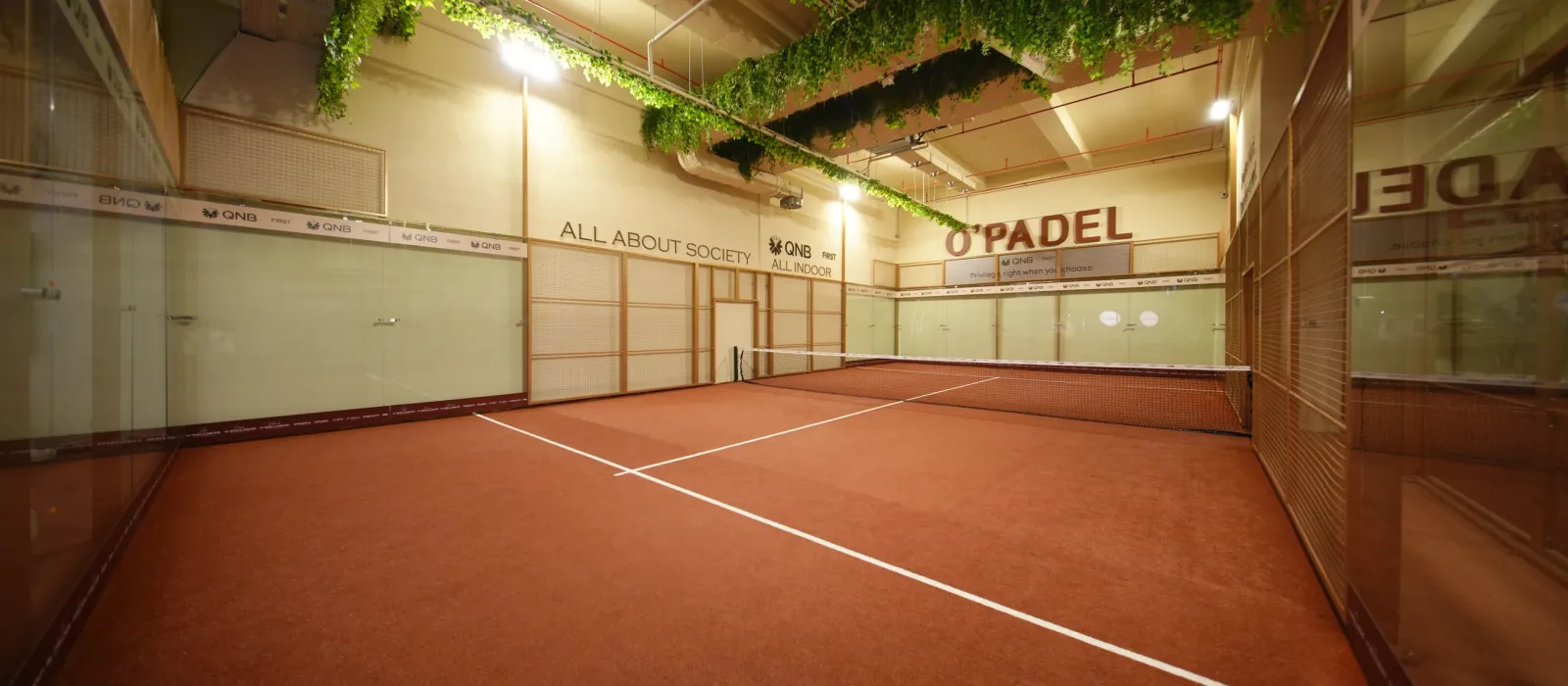
A padel doubles preparation plan is a way for two players entering a tournament together to systematically build their chemistry by working together over a set period on communication, positioning, serve and return order, and match scenarios. In padel, putting two good players side by side doesn't automatically make a good team; chemistry is earned through joint training and deliberate repetition. A four-week plan is a realistic, achievable timeframe for building this chemistry ahead of a monthly club tournament or a league season.
In this article, the O’Padel Sky coaching team shares a four-week preparation program you can follow with your tournament partner. The plan assumes about two joint sessions per week: one training session and one match or match simulation. You can adapt it to your own schedule and level; what matters is keeping the sequence and the focus of each week.
Summary
- Week 1: Defining roles, choosing sides and setting your communication language.
- Week 2: Positioning and moving together; syncing at the net and at the back of the court.
- Week 3: Serve, return order and plans for key points.
- Week 4: Match simulations, opponent scenarios and your tournament day routine.
- Every week: one training session, one match or simulation, and a short debrief.
Before You Start: Shared Goals and Expectations
A productive four-week plan starts with both players looking toward the same goal. That's why we recommend having a short conversation before your first training session. In this conversation, answer these questions together:
- What's the goal? Reaching a certain round in the tournament, playing enjoyable and competitive matches, or getting ready for the next level?
- What does the schedule look like? How many joint sessions can you do per week? Can you set aside a fixed weekly slot?
- What are your strengths and weaknesses? How does each of you see your own game and your partner's?
- What will your feedback style be? How will you give each other feedback on and off the court?
This conversation prevents misunderstandings that could arise in the weeks ahead. Jotting down your answers as short notes lets you look back at your starting point at the end of the four weeks and see how far you've come. We cover the key criteria for choosing a partner in our choosing a padel partner article. For regular joint sessions, see the fixed weekly slot options on our when making your court reservation page.
Week 1: Roles, Sides and Communication Language
The goal of the first week is to write your team's “constitution”: who will play which side, who takes the middle balls, and which words you'll use to communicate on court? Technical and tactical work done before these basic decisions are settled stays incomplete. The decisions don't have to be final; at the end of the first week you can switch sides if needed based on your experience. What matters is entering the tournament with a clear setup that both of you have bought into.
This week's focus
- Choosing sides: Decide on the right (drive) and left (revés) sides. The player with a strong overhead and an effective forehand on the left side usually plays on the left, while the more consistent player who builds the game usually plays on the right. For details, see right and left player roles in padel.
- Middle balls: Decide who has priority on balls down the middle; for example, the player whose forehand faces the middle. See who takes the middle ball in padel.
- Communication language: Turn short calls like “Mine”, “Yours”, “Lob”, “Up”, “Stay” and “Switch” into a shared vocabulary.
Training suggestions
- Middle ball drill: A coach or third player sends balls between the two players; each ball is played with a call.
- Silent vs. vocal rally: Rally first without communicating, then with a call on every ball. Feeling the difference makes the value of communication tangible.
- Social match: Play a match at the end of the week; focus on applying your sides and communication rather than the score.
For communication habits, our partner communication in padel article includes detailed tips.
Week 2: Positioning and Moving Together
In the second week, the focus is on the two players moving as one unit on court. In padel, teams usually move forward and back side by side, along a parallel line. “Split” positions, where one player is at the net and the other is at the back, leave big gaps for the opponents. In this week's drills, working on the movement at a slow tempo first and then gradually increasing the speed makes it easier for your synchronization to click.
This week's focus
- Moving up together: Moving up to the net together after a lob or a deep shot.
- Retreating together: Returning to the back of the court together on a good lob by your opponents.
- Sliding sideways: When the ball goes to a corner, both players slide in the same direction to close off the middle.
Training suggestions
- Imaginary elastic band: The two players move as if connected by an invisible rope; the coach sends balls to different spots to test synchronization.
- Lob + moving up: Hitting a lob from the back of the court and moving up to the net together, then answering the reply with a volley.
- Defensive transition: When at the net, retreating together against the opponent's lob and keeping the point alive with a bandeja or a shot off the glass.
The transition from defense to attack is the most important tactical theme of this week. For details, see moving from defense to attack in padel article.
You need regular court time to follow the four-week plan. Lock in your preparation with a fixed weekly slot on our indoor courts at Skyland Istanbul.
Week 3: Serve, Return and Key Points
In the third week, we focus on the turning points of matches: service games, the return of serve and key points like the golden point. Having a plan set in advance for these moments makes it easier to make decisions under pressure. When the score gets tight in a tournament, there's little time to think; a plan you've repeated many times in training kicks in almost automatically and removes any hesitation.
This week's focus
- Serve plan: Which zone the server will target and how their partner will position at the net. For details, see padel serve tactics .
- Return plan: Which return to favor: deep crosscourt, chiquita, or lob. See padel return of serve.
- Critical point decisions: Who returns on the golden point and which safe shot to favor. For the rule, see what is the golden point in padel our article.
Training suggestions
- Serve games: Play only the serving pair's points; focus on the serve + first volley combination.
- Return series: Respond to the serves of the players acting as opponents with different return options.
- Golden point simulation: In practice matches, start every game at 40–40 so you rehearse critical point decisions again and again.
Week 4: Match Simulations and Tournament Day Routine
In the final week, the goal is to bring everything you have learned together under match conditions and get ready for tournament day. Easing the intensity slightly this week helps you go into the tournament fresh. Instead of trying a new technique or tactic, focus on reinforcing the plan you built in the previous weeks; tournament week is about confidence, not novelty.
This week's focus
- Match simulation: A full match under conditions similar to the tournament format; for example, if the tournament uses golden point or a super tiebreak, play with the same format.
- Opponent scenarios: A plan against different playing styles: an opponent who lobs a lot, an aggressive net player, a left-handed player.
- Tournament day routine: Arrival time, warm-up, nutrition between matches, and a communication plan.
The table below summarizes the overall framework of the four weeks and the check-in question to ask at the end of each week:
| Week | Theme | End-of-week check-in question |
|---|---|---|
| 1 | Roles, side, communication | Do we hesitate over who takes the balls down the middle? |
| 2 | Positioning and moving together | Do we stay level with each other when moving forward and back? |
| 3 | Serve, return, critical points | Do we both know what we'll do on the golden point? |
| 4 | Simulation and tournament routine | Can we play a full match in tournament format while sticking to our plan? |
When working on opponent scenarios, set a “Plan A” and a “Plan B” for each one. For example, against an opponent who lobs a lot, Plan A might be holding the net with a patient bandeja, while Plan B is retreating together when needed and rebuilding from defense. Also agree in advance who will make the call to switch to Plan B if Plan A isn't working during the match.
For opponent analysis, see scouting opponents in padel; for tournament day preparation, see match day at a padel tournament .
Weekly Review: Short but Regular Conversations
The most overlooked yet most valuable part of the plan is the short review conversation at the end of each week. Looking back together for a few minutes, while the moments on court are still fresh, sharpens the focus for the following week.
To make the review conversation productive, we suggest this simple structure:
- One thing that went well: Each player names one thing you did well as a pair that week. Starting on a positive note sets the tone for the conversation.
- One thing to improve: Each player names one area they want to improve as a pair. Not in a blaming way, but using “we” language.
- A single goal for next week: Set one concrete goal to focus on together.
It's important to keep this conversation short; the aim isn't lengthy analysis but building a habit of regular, constructive feedback. Keeping your notes in a shared place lets you see how far you've come by the end of the four weeks. Doing a review with the same structure after the tournament also gives you a solid starting point for your next preparation block.
Physical Preparation and Recovery
During the four-week preparation period, individual physical conditioning matters alongside your joint sessions. Tournaments may require playing several matches on the same day, which demands endurance and recovery capacity.
- Conditioning: One or two short conditioning sessions a week: leg strength, core, and short interval work. See conditioning program for padel.
- Balancing the load: Reduce intensity in the final week so you go into the tournament fresh.
- Sleep and nutrition: Regular sleep and balanced nutrition in the days before the tournament; for the effect of sleep on reaction time, see sleep and padel performance post.
- Recovery: Cool-down and stretching after intense sessions, plus O’Spa Sky facilities when needed. For details, see recovery & wellness page.
If you pick up an injury or persistent pain during preparation, consult your doctor instead of continuing to play under pressure to make the tournament. Communicating openly with your partner about this also matters for the health of the partnership. Missing one tournament is always better than losing the season to a long-term injury.
Conclusion
A four-week pair preparation plan lets you build chemistry with your tournament partner step by step instead of leaving it to chance, from roles and communication to positioning, from your serve plan to critical points and match simulations. Short reviews at the end of each week speed up how quickly the pair learns together. At O’Padel Sky, located within Skyland Istanbul in Sarıyer, you can put this plan into practice on our indoor, FIP-standard courts and bring what you learn to the court in our in our tournaments and leagues which range from Americanos to the monthly club tournament. As the O’Padel Sky coaching team, we're here to support your pair training; for lesson options, see padel lessons and for our courts, see padel courts pages.
FAQ
The plan is a framework; if a week's theme hasn't clicked, repeating that week is completely normal. You can extend the plan through to your next tournament.
Yes, but you may need to extend the timeline. You can spread each week's theme over two weeks and progress at a calmer pace.
It isn't mandatory, but a coach's outside perspective makes it easier to spot positioning and communication mistakes. A pair lesson can be especially productive in weeks 2 and 3.
Have a short, calm conversation on court and focus on the next point; save the detailed review for after the match. The feedback rules you set during preparation come in handy in these moments.


 Padel Courts
