
Salida de pared is one of the most characteristic movements in padel and refers to meeting the ball as it bounces off the back glass and returns into court. This Spanish term meaning 'exit from the wall' confuses beginners especially, because after hitting the wall the ball arrives at an unexpected angle and height. Played correctly, this shot is the first step in moving from defence to attack. In this guide we explain the logic and practice methods you can use on glass-walled courts like those at O'Padel Sky.
Reading how the ball returns off the glass
Everything begins with predicting how the ball will come off the glass. A flat, slow ball hitting the glass squarely returns straight back; an angled, fast ball goes sideways and cuts the court on a different diagonal. Watching the opponent's shot speed, angle and spin gives you the signals needed for positioning.
After the glass the ball usually slows and loses height. So the reaction time is somewhat longer, but a misread ball can suddenly come right into your body. It is important to wait behind the glass and watch the bounce, never taking your eyes off the line of the ball's return.
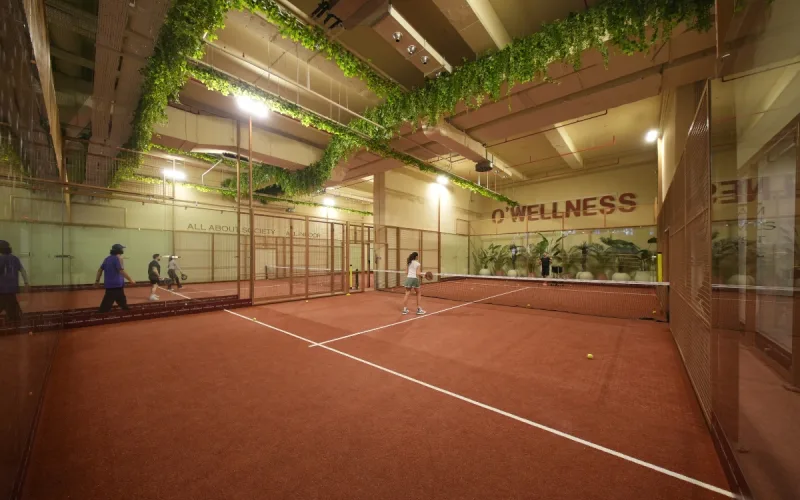
On indoor courts, because the glass surface and floor are consistent, exit angles are more predictable. This is an ideal environment for practising salida de pared, because seeing a repeating pattern of exits quickly develops your reading skill.
Positioning and footwork
Meeting the ball right at the foot of the glass narrows your hitting space. Instead, leave yourself a step of space as you approach the glass and don't step backward while waiting for the ball to hit it. The ideal position is slightly to the side of the ball's return line, with the body standing slightly sideways between the ball and the racket.
Footwork has two stages: first, on seeing the ball will go to the glass, you take position with short, quick steps backward; then, as the ball comes off the glass, you move forward onto the ball shifting your weight ahead. This forward movement adds power and balance to the shot.
The split step matters here too. A small hop at the moment the ball hits the glass prepares you to both change direction and accelerate. Waiting motionless usually results in being late.
Shot technique
The salida de pared shot calls for a short, controlled movement. Instead of a big backswing, keep the racket close with a compact preparation; the ball usually returns slowly, so you don't need to draw power from the body. Meeting the ball in front of the body provides the control needed to set direction.
The goal is mostly defensive: sending the ball deep through the middle and toward the opponent's feet, or escaping a net-dominating opponent with a high lob. If the situation allows, you can also counter-attack by taking the ball to the angle according to the opponent's position.
- As soon as you see the ball heading to the glass, take a step back into position
- Wait a step away from the glass, not right against it
- Shift your weight forward as the ball comes off the glass
- Hit with a compact, short preparation
- Target: deep middle or high lob
Common mistakes
The most common mistake is chasing the ball right into the foot of the glass and then getting cramped. In that case the racket has no room to move and the shot usually falls weakly in the middle of the court. Another frequent mistake is trying to hit unnecessarily hard; salida de pared is mostly a control shot, not a power shot.
Another mistake is going for the shot before waiting for the ball to hit the glass. This behaviour, which breaks timing, makes you catch the ball on the tip or edge of the racket. Patience is the most valuable virtue in this shot.
Communication with your partner should not be forgotten either. In doubles, if it isn't clear who takes the ball coming off the back glass, confusion arises. A clear call prevents clashes and a ball left untouched.
Exit differences by glass type
The back wall of every court is not the same. In some courts the back wall is entirely glass, in others the lower part is wall and the upper part glass. Wall and glass bounces differ; glass returns faster and slicker, while a flat wall may leave the ball a bit heavier. When playing on a new court, spending the first few minutes observing this difference is very valuable.
Because the courts in an indoor facility are generally built to the same standard, behaviour you learn once applies on other courts too. This consistency is one of the reasons players who keep playing in the same place improve faster at glass play.
In addition to speed, spin also affects the exit from the glass. A ball with topspin accelerates forward after the glass; a ball with underspin slows and comes up steeper. Observing the spin of the opponent's shot gives important clues about how the ball will behave after the glass.
Sharing roles in doubles
Taking the ball coming off the back glass is mostly the job of the player staying back. The partner standing near the net, meanwhile, adjusts position by covering the middle of the court and anticipating a possible short ball. This coordination makes the transition from defence to attack a joint movement.
If the ball is very high or very fast, asking the partner for a step back or a swap is also possible. Clear communication prevents both players from going for the same ball or both leaving it. Short calls and hand signals are enough here.
For left-handed players and players on the right side, exit angles from the glass can feel different. Taking this detail into account when setting roles in the team increases defensive efficiency.
Taking the practice into the match
A salida de pared that works in training can feel different under match pressure. To prevent this, make the exercises gradually harder: first slow balls, then fast balls and finally scored play. Adding a short 'glass inside the rally' section to the practice lets the technique also work in match conditions.
Be patient with balls coming off the glass in the match. Instead of rushing into short shots, recovering with a defensive shot and extending the rally often gives better results. Correct timing creates a consistent feeling of confidence within a short time.
Finally, reviewing your own errors on video is useful. Watching how you prepare for the ball coming off the glass, your foot position and the timing of your shot in slow motion shows clearly the details you need to correct.
Practice suggestions
A coach or partner feeds balls at different angles toward the back glass and you return the ball coming off the glass in a controlled way. Start with slow balls, then increase speed and angle. Setting a target to send to the same place each time develops consistency.
Taking lessons is also a very valuable option. A coach can observe your footwork and timing and suggest personal corrections. Glass play is frequently practised in lessons at Sky; getting regular feedback on it speeds up learning.
Be patient. Glass play is one of the hardest aspects of padel and mastery takes months, not weeks. Give twenty minutes of every session to this shot and watch how your friendship with the glass develops at O'Padel Sky.


 Padel Courts
