
A ball aimed at your body in padel is a situation every player at the net faces sooner or later. When opponents cannot find an angle or want to catch you unprepared, they direct the ball straight at your chest, hip or shoulder. These balls are fast, and because they come to the middle of your body it is hard to decide whether to use the forehand or the backhand. In this article we look at the racket position specific to these moments, foot adjustment and ways to send the ball back safely.
Why do opponents play at the body?
The tactical logic of playing at the body is simple: a player is most comfortable when hitting with the arms extended away from the body. When the ball comes right to the middle, the arm's range of motion narrows and the shot gets cramped. The opponent wants to use that cramping to force you into a weak return. A ball at the body can also create hesitation about which of the two players should take it.
This shot is especially common in close-range exchanges at the net, in other words fast rallies where both pairs are in front of the net. These rallies last a few seconds and each ball arrives faster than the one before. Without the right habits, you usually come out of these exchanges having lost the point.
It would be wrong to think a ball played at the body is always meant maliciously. It is a legitimate part of the game and good players use it in a controlled way. Still, in social matches and settings where players of different levels play together, showing restraint with hard shots from close range protects trust on court.
Some opponents use this shot more often at certain moments, for example while you return to the net position after a smash or bandeja, or during the short transitions when you switch places with your partner. Recognizing these moments lets you prepare your defense in advance. Noting after the match in which situations balls came at your body also reveals the opposing pair's habits.
The ready position: half of the defense
Your biggest advantage against a ball at your body is your position before the ball arrives. Holding the racket head at chest height, in front of the body and slightly toward the backhand side is a good start. This position makes it easier to meet balls coming to the middle of your body with a short backhand block. If the racket is waiting low or out to the side, bringing it up in time is almost impossible.
Many coaches recommend meeting most balls that come to the middle zone with the backhand. The reason is that a backhand block can cover a wider area in front of the body. Taking a ball close to the body with the forehand requires pulling the elbow back and moving away from the body, which takes time. A waiting position close to the backhand side buys that time.
The position of the feet also matters. While waiting for the ball, the feet should be shoulder-width apart, the weight shifted toward the balls of the feet and the knees slightly bent. A player standing on their heels falls backward against a ball at the body and loses balance. Putting the weight forward both adds power to the block and helps you get ready for the next ball faster.
The short block and making room
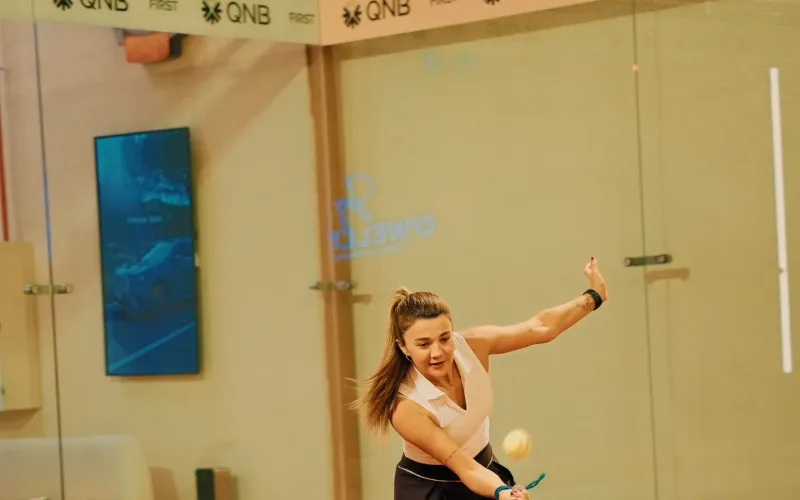
The safest way to meet a fast ball at your body is a short block. Put the racket in the ball's path, keep the face slightly open and do not swing. The ball's own pace is enough to send it to the other side. The aim here is to keep the ball low, toward the ground or toward the opponents' feet. A block that stays high gives the opponent a second, easier shot.
It is also important for the racket head to stay above the wrist in the block. If the racket head drops on a chest-high ball, the face opens and the ball rises. Keeping the racket head up and fixing the elbow in front of the body, slightly out to the side, makes it easier to control the face at contact. This stance may feel restrictive at first, but it becomes natural with repetition.
If there is time, pulling your body out of the ball's path with a small side step, in other words making room for yourself, makes things easier. Thanks to this step, the ball no longer comes right to the middle of your body but slightly to the side, and you can play a more comfortable shot. But this step must be very small and quick; a big movement ruins the timing.
- Keep the racket at chest height and in front
- Prefer the backhand block for balls in the middle zone
- Do not swing; use the ball's pace
- If there is time, make room with a small side step
- Keep the block low and direct it toward the opponents' feet
When does a step back make sense?
In some situations the best defense is to step back from the net. If the opponent is about to hit hard downward from very close range, being a few steps back gives you reaction time. This retreat should be controlled, not panicked. You can then rebuild the rally by meeting the ball with a block or a soft lob.
Communication with your partner is also decisive with balls at the body. A ball coming between the two players can fall both onto one player's body and into the other's backhand zone. A simple rule set in advance, such as the player with the forehand side forward taking middle balls, reduces hesitation. Whoever takes it giving a verbal signal also lowers the risk of collision.
Briefly discussing these rallies with your partner after the match keeps you from hesitating the same way next time. Remembering which ball you both waited on and which you both reached for clarifies how you share responsibility.
The mental side should not be forgotten either. A hard ball at the body can startle a player, especially the first few times, and make them pull back on later balls. This is a natural reaction. As you make a few successful blocks with correct technique, this timidity fades and you begin to stand more comfortably at the net.
Safety and training
Fast, close-range balls are among the situations that most often cause small knocks on court. So safety must come first when practicing defense. Sending the balls slowly and predictably at the start of training helps both to settle technique and to reduce fear. Pace should be increased gradually as confidence in the technique builds.
An effective drill can be set up like this: one player stands near the net and the other sends controlled-pace balls at their body from behind the service line. The player at the net responds only with a backhand block and tries to direct the ball toward the other side's feet. After a few minutes the roles switch. This simple setup develops reflexes and racket position at the same time.
It is also worth being aware of eye protection. Some players prefer protective glasses in fast, close-range play. This is a personal decision, but it can be considered especially in training with children or beginners. Talking this over with coaches at clubs such as O'Padel Sky helps you settle on the approach that suits you best.
FAQ
Should I use the forehand or backhand for a ball at my body?
Most coaches recommend a backhand block for balls in the middle zone because it covers a wider area in front of the body. If the ball clearly comes to your forehand side, the forehand may feel more natural.
Is playing at the body against the rules?
No, it is within the rules. If the ball touches a player, that player's side loses the point. Still, playing with restraint from close range is a courtesy in social matches.
How can I improve my reflexes?
Block drills that start at a controlled pace and get gradually faster are the most practical route. A correct waiting position also means your reflexes are under less strain.


 Padel Courts
