
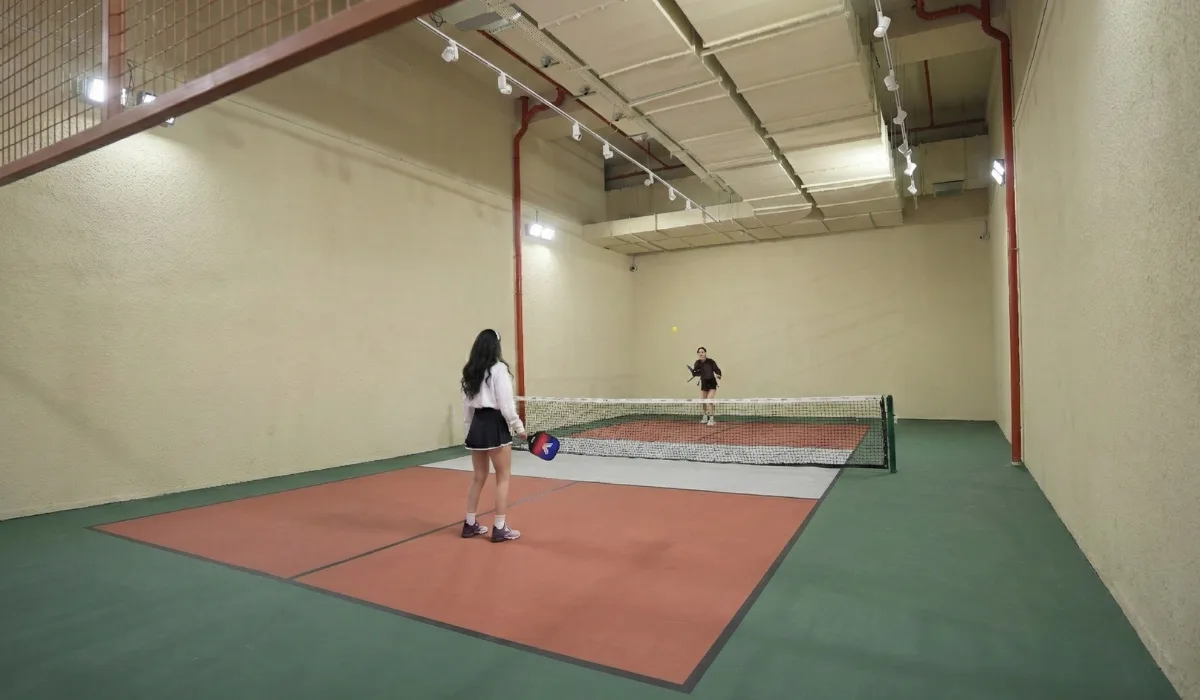
The question 'is padel hard' is on the mind of most people who have just become curious about the sport. Glass walls, different rules, foreign terms and the expectation of opponents can be intimidating at first glance. But padel is a sport that is noticeably easier to learn than other racket sports and offers beginners fun from day one. In this article we address the seven fears beginners voice most often and try to give realistic answers based on the O'Padel Sky experience.
Fear 1: How will I play the ball off the glass?
The glass wall is the scariest but most fun side of padel. In the first lessons it is enough to observe how the ball comes off the glass and not to hurry to include it in play. Most people begin to sense the ball's return angle within a few sessions.
Moreover, the ball coming off the glass usually slows down and gives you more time to hit. Compared with tennis, a ball the opponent misses can still stay in play thanks to the glass, which lengthens rallies and increases enjoyment.
Fear 2: My fitness is not enough
Padel court dimensions are small and since it is played in doubles the space is shared. So the running distance is lower than in tennis. At beginner level rallies are short, so even with moderate fitness it is possible to have an enjoyable session.
Fitness develops on its own as you play. You can support it with brisk walking or light cardio. If you have a health condition, consult your doctor first and set the tempo to suit you.
Fear 3: Am I too old?
Padel is a sport played by people of all ages. Since the court is small, the ball slow and the game strategic, experience and tactics can balance physical strength. From children to players over sixty, everyone can find a place on court. Paying attention to joint health, not skipping the warm-up and choosing a tempo suited to the level is enough.
That said, if you have a known heart, joint or spine condition, getting your doctor's approval before starting is advised.
- Fear 4: I have no partner, who will I play with?
- Fear 5: Racket and equipment will be too expensive
- Fear 6: Everyone is better than me, I'll embarrass myself
- Fear 7: Learning the rules is too complicated
Fears 4 and 5: Partner and equipment
If you have no partner, don't worry. Clubs usually organise pairing events, Americano nights and sessions dedicated to beginners. These events let you meet new people and find opponents suited to your level.
On equipment, renting or borrowing a racket is enough in the early period. Your sportswear and comfortable shoes are usually enough to start. Decide on a big equipment investment after you have realised you truly like the game.
Fears 6 and 7: Judgement and rules
Everyone was once a beginner. The padel community usually welcomes new players warmly and treats first-day mistakes with understanding. Choosing a group suited to your level and taking lessons greatly reduces this worry.
The rules are simpler than you think. The serve is underhand, the ball can be played after one bounce or off the glass and scoring is similar to tennis. During the first lesson the coach explains the basic rules in a short time. The rest is learned as you play.
A realistic expectation of progress
Every beginner tends to compare their rate of progress with others. Yet the speed of learning varies according to previous racket sport experience, age, frequency of regular play and whether lessons are taken. Those who have played tennis or squash before usually start fast, but this is a personal journey, not a race.
As a general framework, being able to sustain simple rallies after a few sessions, playing scored games after a few weeks and beginning to think strategically after a few months are reasonable goals. These are not exact times but indicators of direction.
Remember that progress is not linear. Some weeks you improve quickly while in others you feel a plateau. These plateaus are often the precursor to the next leap. What matters is carrying on without quitting and noticing small gains.
Taking the first step
Most fears vanish with experience. Once you see the ball hit the glass and come back on court, you realise how natural and fun the sport really is. So the best solution is to take a small step and plan the first lesson or first session.
From a health perspective, precautions are needed too: if you have heart, joint or other health problems, consult your doctor before starting. Warming up, drinking water and listening to your body are enough for a safe start.
Emotional barriers
The reluctance felt when starting a new sport mostly comes not from physical inadequacy but from the fear of looking like a novice in front of others. This fear is normal; but the social nature of padel helps you overcome this barrier quickly. An environment where everyone laughs together, makes mistakes and has fun creates a comfortable learning space.
One way to reduce this feeling is to do the first session with a friend you trust. Another is to join events dedicated to beginners; there everyone is at the same level and nobody judges anybody. Welcome nights at clubs can be used for this purpose.
Remember, the players on the other side of the court were once in your place too. They also missed the ball, got stuck at the glass and confused the rules in their first sessions. This shared experience is like an invisible thread binding the community together.
If your fears still hold you back, taking a one-to-one lesson with a coach can be a safe start. One-to-one lessons offer an environment where all attention is on you and your mistakes are judged by no one.
In conclusion, padel isn't hard; it's unfamiliar. And what is unfamiliar quickly becomes familiar as you try it. Take the first step you want to take today.
There is also the preparation side: no special clothing is needed for padel. A comfortable sports shirt, flexible shorts or leggings and suitable sports shoes are often enough. Since the climate is constant on an indoor court, dressing in layers and removing one when needed gives enough comfort.
Also if you wonder how to behave on court, don't hesitate to ask coaches or club staff in the first session. For them helping newcomers is a natural part of the daily job and asking questions is entirely welcomed behaviour.
The reality: easy to learn, hard to master
The appeal of padel lies exactly here: you enjoy it on day one and over the years meet a game that deepens. The difficulty is not a barrier to starting but a reason to keep going. Learning something new in every session keeps the sport alive.
Whatever your fears, the best answer is to try on court. Take your first lesson at O'Padel Sky in Skyland Istanbul and see for yourself that padel is far more accessible than you think.



 Padel Courts
