
Padelde duvarlar yalnızca sınır değil, birer silahtır. Orta-ileri seviyede bu silahı en etkili kullanan çiftler, rakibi cama sıkıştırmayı bilinçli bir plan olarak uygular: topu öyle bir açı ve derinlikle gönderirler ki rakip, ya zor bir camdan dönen top alır ya da köşede kalıp kontrolsüz bir cevap verir. Bu planın doğru işlemesi puanın büyük kısmını kurar.
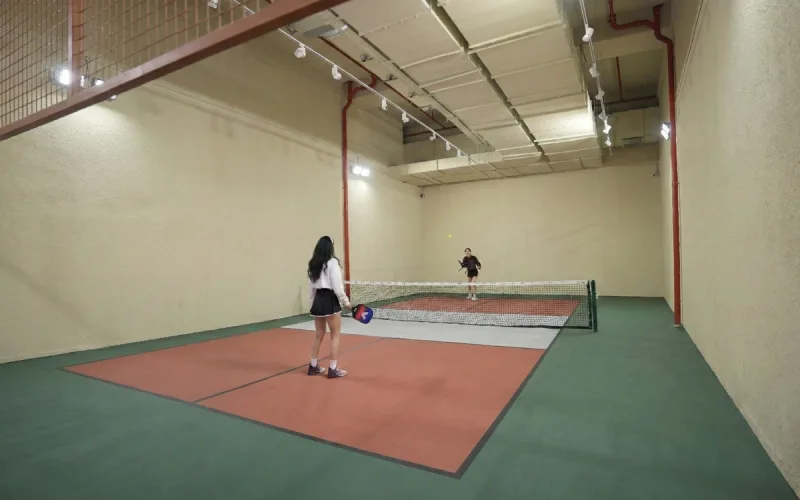
On indoor courts such as O’Padel Sky in Skyland, knowing the glass response is the basis of the pinning plan.
There is a sentence players often say about using the glass: “I send the ball to the glass but I don’t know what will happen.”” This article explains the logic of pinning step by step to reduce that uncertainty.
In summary, pinning the opponent to the glass is not a show of force but a construction of distance, direction and patience. Asking before every point “where can I send the ball so that the opponent’s space narrows?” is the first step to turning this construction into a habit.
Why Does Pinning Work?
An opponent standing near the glass loses movement space. They cannot swing the racket freely, the room to stretch backward shrinks and shots stay short. An opponent pinned in the corner mostly sends a high, weak ball, which means a smash or bandeja chance for you.
The second benefit of pinning is disrupting the opponent’s positional balance. A player trying to get out of the corner struggles to return to the center after taking the ball. In this transition time the partner’s load increases and a gap forms between the pair. A second shot toward this gap raises the chance of closing the point.
The concept of pinning is often confused at intermediate-advanced level with the idea of “move the opponent.” The two are similar but different: moving means sending the opponent from one place to another, while pinning pushes them to a point where freedom of movement is restricted. One targets tempo, the other control. A pair that uses both together both tires and pressures the opponent.
The Basics of Creating Angles
The first rule of creating angles is to send the ball toward the far sideline of the court. A crosscourt shot passes over the lowest point of the net and uses a longer distance of the court. It then follows a path that hits the side glass and moves away from the opponent. A down-the-line shot pins the opponent directly to the side glass but leaves less margin for error.
The second component of the angle is spin. A slightly sliced ball lowers and slows after hitting the glass, making it harder for the opponent to reach. A ball with topspin speeds up and rises after the glass. Which spin works in which situation needs to be tested against the court surface and the response of the glass.
- Use crosscourt shots to direct the opponent toward the corner and away from the side glass
- Send a deep ball; a short ball gives the opponent a chance to recover
- Use a slightly sliced ball to create a trajectory that lowers after the glass
- Watch the position of the pinned player’s partner
Which side of the court you pin on also matters. A right-handed player pinned in the left corner is forced to the backhand, which is the weaker side for most players. In the right corner, the forehand stroke comes into play. Observing which corner the opponent is worse in during the first few points determines the pinning target.
With left-handed opponents this equation reverses. A left-handed player’s forehand works in the left corner. So knowing in advance which hand the opponent uses and which side they are comfortable on guides target selection.
Depth: The Key to the Corner
Pinning works only when the ball is deep enough. A short ball allows the opponent to hit from the middle of the court; a deep ball pushes them into the corner of the back court. The corner where the back glass meets the side glass is one of the hardest areas in padel, because the ball can bounce there unexpectedly.
Depth control in practice is mostly a matter of height. Having the ball clear the net high enough creates a longer trajectory and makes it land deep. A ball that is too high gives the opponent time, though. A medium height is the balance that gives both depth and pressure.
Your position after pinning is also critical. Moving in sync with your partner as you advance toward the net is necessary to close the opponent’s return. If one of you advances while the other stays back, the opponent’s answer can find the gap in between and save the point. Both players stepping forward at the same time creates a shared rhythm.
Repeated success in the pinning strategy comes with a patient rhythm. If pinning does not work on one point, applying the same plan with a slight change on the next is enough. Trying directions and depths with enough variety not to shorten the opponent’s adjustment time keeps the plan effective even in long matches.
What to Do After Pinning
The first job after pinning the opponent is to be patient. Many players, seeing the opponent struggling in the corner, try to finish the point immediately and make mistakes. A pinned opponent will usually send a weak ball. Moving a step toward the net and waiting for this ball is much safer than a rushed shot.
When the weak ball comes, finishing options vary: a smash, a bandeja or a volley placed into a gap. Which one is right depends on the opponents’ positions and the height of the ball. If the partner of the pinned player is left exposed, a shot toward that gap often closes the point.
The pinning strategy also has a mental side. When an opponent is troubled in a corner many times, confidence is shaken and they turn to evasive shots. This offers you additional chances. But to trigger this effect you need to avoid showiness and insist on simple, safe shots; fast and risky attempts usually bring mistakes instead of the plan.
Knowing the Risks
The pinning strategy has its risks too. A plan leaning too much on the glass can lead the opponent to get used to rebounding balls and turn them to their advantage. The opponent can turn a ball you sent toward the glass in their own favor with a strong contrapared. That is why you need to change direction from time to time and not repeat the same pattern for every ball.
Another risk is that a ball sent at the wrong angle gives the opponent an easy chance to play through the middle. A ball sent very close to the side glass at a narrow angle may sometimes bounce exactly where the opponent expects. Not losing sight of your own position when choosing the angle lets you anticipate where the answer may come from.
How to Practice It
To practice this strategy, set up a simple game: two players send each other deep crosscourt balls, and the aim is to push the opponent into the corner and win a weak ball from them. When the weak ball arrives, the other side tries to finish the point. This game teaches the balance among depth, angle and patience in real conditions.
After the match ask yourself: how many times did I pin the opponent and get a weak ball, how many times did I rush? The ratio between these two numbers shows the quality of plan execution. If you have a muscle or joint problem, consult your physician.
FAQ
Which shot is best for pinning an opponent?
A deep crosscourt shot is usually the safest. A slightly sliced ball makes the opponent’s job harder by lowering after the glass.
Should I finish immediately after pinning?
No. It is safer to wait for the opponent to send a weak ball and move toward the net.
Is this strategy different on an indoor court?
On an indoor court glass responses can be more predictable; still, every court has its own bounce, so trying a few balls in the warm-up is useful.


 Padel Courts
