
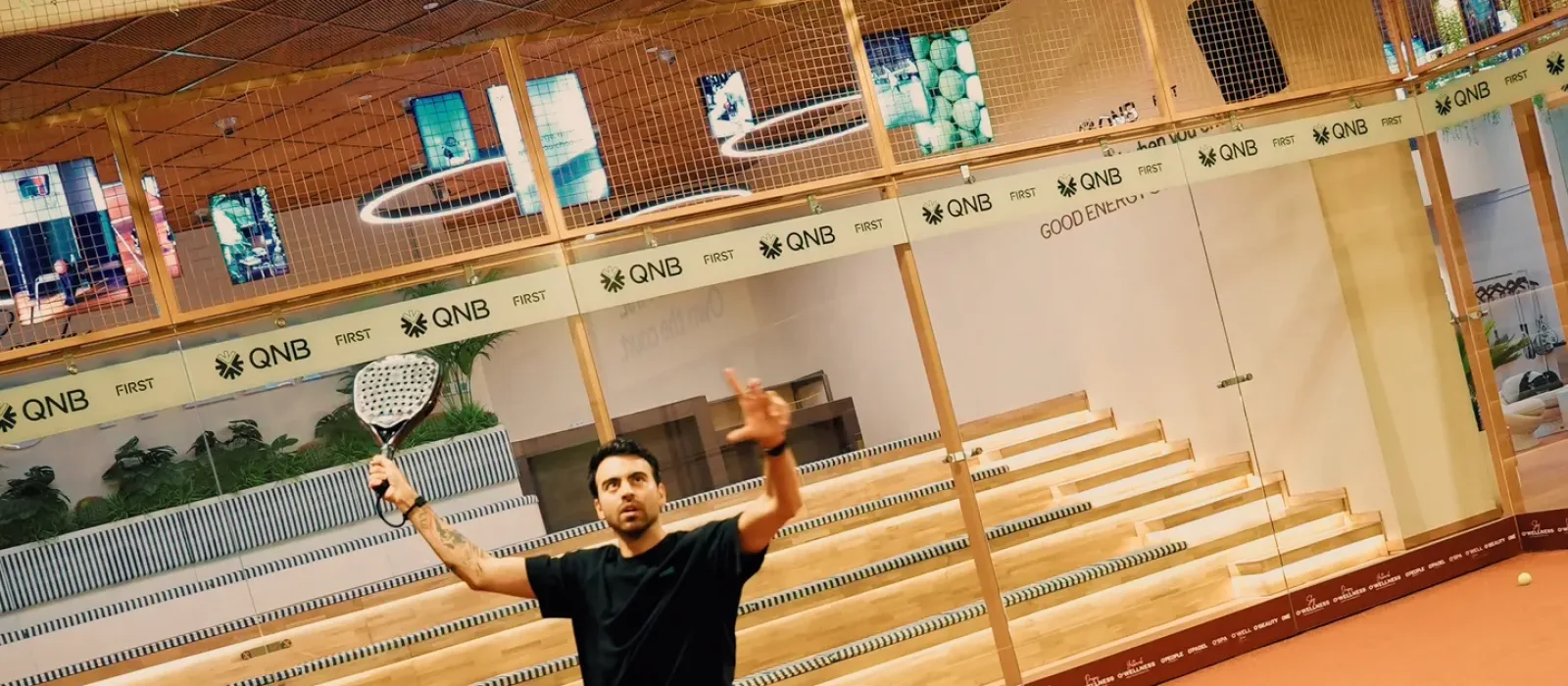
Private lesson or group lesson in padel is a decision nearly everyone who starts the game faces. The two have different strengths, and the right answer varies with your level, your goal, and your budget. In this article we compare the two formats systematically, look at which is more efficient at which stage, and cover a hybrid approach that combines both.
The Core Difference: Repetitions and Attention
The math that separates the two formats is simple. In a 60-minute lesson:
- Private lesson: All the attention is on you. You might hit roughly 300-400 balls. You can get feedback on every shot.
- Semi-private lesson: Attention is split in two. The number of shots drops by about half, but your rest time increases.
- Group lesson of four: Attention is split four ways. Individual correction time is about a quarter of the lesson.
But this math alone is not enough, because padel is a doubles game and some skills can only be learned in real game situations.
Strengths of Private Lessons
- Speed of technical correction: The most effective format for fixing a faulty pattern. The difference is clear in complex movements such as the bandeja or the serve.
- High repetition count: Motor learning requires repetition.
- Personalization: The program is built entirely around your weak points.
- Tempo control: If you learn fast, you don't have to wait; if you learn slowly, you aren't under pressure.
- Ease of asking questions: Important for those who feel shy in a group.
- Video analysis: There is time for individual recording and review.
- Flexibility: Easier to agree on lesson times.
Strengths of Group Lessons
- Real game situations: Padel is played by four people; a group lesson naturally provides this dynamic.
- Partner communication: Decisions like “who takes it” and “who covers” are only learned in real play.
- Tactical development: Positioning, reading gaps, and analyzing opponents develop within a group.
- Cost: Cost per person is noticeably lower.
- Social component: The easiest way to find playing partners; it improves consistency.
- Learning by observation: Watching others' mistakes and corrections is instructive.
- Rest intervals: More sustainable for those with limited fitness.
- Competitive motivation: Working with players of a similar level creates drive.
Recommendations by Level
Never played (0-1 month)
Recommendation: 2-4 private lessons, then move to group lessons.
In the first lessons, setting up the basic patterns correctly is critical. The racket grip (continental grip), basic forehand and backhand, serve mechanics, and court position settle in during this period. Getting this foundation wrong creates habits that are hard to fix later.
Beginner (1-6 months)
Recommendation: One group lesson per week + 1-2 private lessons per month.
Group lessons provide game practice and a tactical foundation; private lessons fine-tune technique. In this period, padel-specific skills such as wall play and the bandeja come into play.
Intermediate (6 months – 2 years)
Recommendation: One group lesson per week + free play + a private lesson every 1-2 months.
At this stage the biggest gain comes from hours of play. Private lessons are used to focus on a specific weakness (for example the víbora or returning serve).
Advanced
Recommendation: Depends on the goal; in tournament preparation the weight of private lessons increases.
Doubles lessons taken together with a partner are especially valuable at this level; pair chemistry and tactical coordination are worked on.
Hybrid Approach: The Most Efficient Model
For most players, the model that gives the best result is to combine the two formats.
Example monthly program (intermediate)
- Week 1: Group lesson + 1 free match.
- Week 2: Group lesson + private lesson (technical focus) + 1 free match.
- Week 3: Group lesson + 2 free matches.
- Week 4: Group lesson + Americano or Mexicano night.
This structure adds up to 4 group lessons, 1 private lesson, and 4-5 hours of play per month. It covers the technical, tactical, and social components.
Cost Comparison
Prices vary by club and coach, but the relative ratio is generally as follows:
- Private lesson: Base unit price.
- Semi-private lesson: About half per person.
- Group lesson of four: Roughly between a quarter and a third per person.
A practical approach to budget planning: with the same budget, you can take 3-4 group lessons instead of 1 private lesson. In the early beginner period private lessons offer a higher return; afterward the balance shifts in favor of group lessons.
The Place of Free Play
Neither private nor group lessons replace free play. The skills you learn need to be applied under pressure, with a score, and in unplanned situations.
- Ideal ratio: 2-3 hours of play for every 1 hour of lessons.
- Taking lessons only and never playing: Technique improves but game reading does not.
- Only playing and never taking lessons: Faulty patterns become entrenched and you plateau at a certain level.
- Finding a partner: Group lessons and Americano nights are the easiest way to do this.
What to Look for When Choosing a Group Lesson
- Level homogeneity: The group's level should be close to yours. In a group that is too advanced you can't hit the ball; in one that is too far behind you can't improve.
- Group size: Four people is ideal. In groups of 5-6, individual time drops sharply.
- Consistency: Working with the same people every week improves group dynamics and partner chemistry.
- Lesson structure: It should not just be playing matches; it should include a technical section.
- Coach's individual attention: Does the coach give feedback to every player in the group?
What to Look for When Choosing a Private Lesson
- Single-topic focus: Every lesson should come with one main goal.
- Repetition count: How long does the coach talk, and how long do you hit?
- Use of video: Seeing your own movement speeds up learning.
- Homework: A suggestion you can work on by yourself after the lesson.
- Progress tracking: Checking the topic worked on in the previous lesson.
FAQ
I've never played; can I go straight into a group lesson?
You can, but taking a few private lessons speeds up progress. Many clubs offer a “beginners group” format; that is a good alternative too.
Can my partner and I take lessons together?
Yes, the doubles lesson format is suitable for this and is valuable for working on pair chemistry.
How many lessons per week are enough?
One lesson and two hours of play per week is a balanced start for most players. Those who want to progress faster can go up to two lessons per week.
When can I stop taking lessons?
There is no set point. Even advanced players take lessons at intervals; during plateau periods an outside eye makes a critical difference.
Will I feel embarrassed if my level is low in a group lesson?
The padel community is generally welcoming to beginners. If you are placed in a group matched to your level, this concern passes quickly.
Conclusion
Private lessons and group lessons are not alternatives to each other; they are two tools to be used in different proportions at different stages. In the first week and month, private lessons give the highest return for setting up basic technical patterns correctly. Afterward, group lessons develop real doubles dynamics and tactical reading, while free play is where what you have learned is tested under pressure. The most efficient model is the hybrid approach that combines all three: one group lesson a week, one or two private lessons a month, and regular hours of play.


 Padel Courts
